
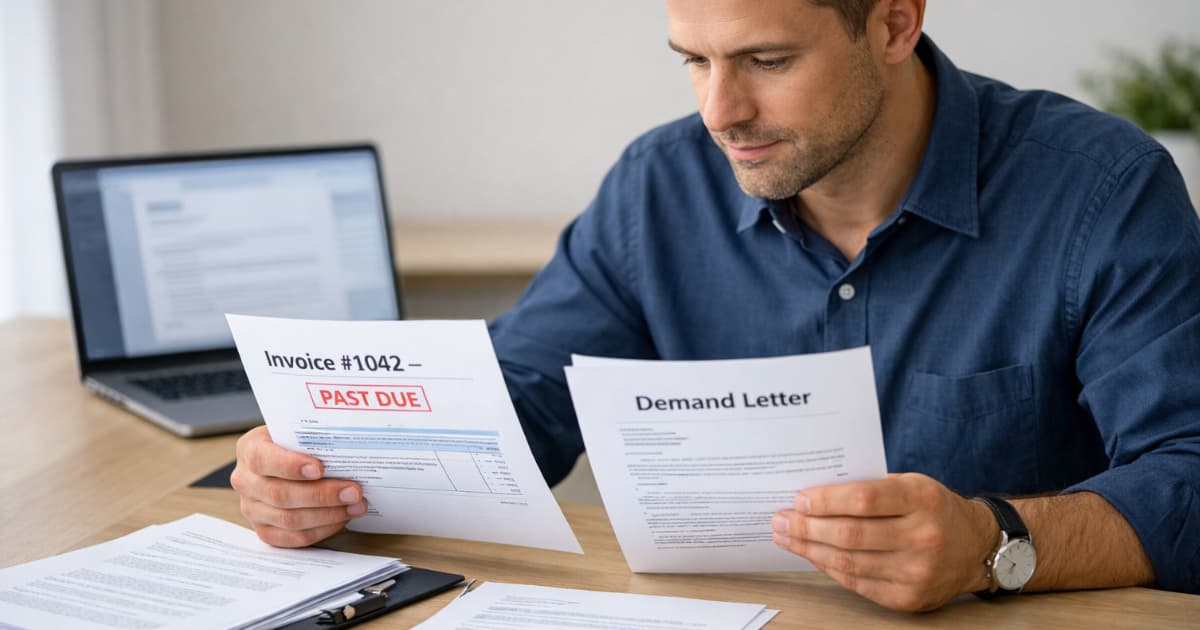
When an invoice goes unpaid for weeks despite reminders, the situation shifts from inconvenience to business risk. You have followed up. You have applied late fees if your contract allows it. You may have even paused work. Now the question becomes more serious:
Is legal action the right next step?
Before escalating to court, you need to evaluate the financial reality, the strength of your documentation, and the practical likelihood of recovery. Legal action is not emotional. It is a cost-benefit decision.
This guide walks you through how to evaluate that decision properly.
Disclaimer: This article is for educational purposes only and does not constitute legal advice. Laws and procedures vary by jurisdiction. Consult a qualified attorney in your area for legal guidance.
Step 1: Evaluate Whether Legal Action Makes Financial Sense
Not every unpaid invoice should go to court.
Ask yourself:
How much is owed?
If the invoice is small, the time spent preparing documentation and attending court may exceed the value of the debt.
Is the client still operating?
If the client's business has closed or filed for bankruptcy, a court judgment may not result in actual payment.
Do you have a signed agreement?
Without a written contract or clear proof of terms, your position weakens significantly.
Before considering court, make sure you have already followed a structured escalation process. If you have not done that yet, review Client Won't Pay? An Escalation Plan for Freelancers.
Legal action should be the final stage, not the first.
Step 2: Send a Formal Demand Letter
Pre-filing requirements differ by court and jurisdiction. Check the rules for the court you may use before assuming that a particular demand format or deadline is required.
A demand letter should include:
- The total amount due
- A summary of the services delivered
- The original invoice date and due date
- Any applicable late fees outlined in your agreement
- A firm deadline for payment that is reasonable under the applicable rules
- A clear statement that you will initiate legal proceedings if payment is not received
Send it via certified mail if possible and keep proof of delivery.
Often, a properly structured demand letter is enough to trigger payment without court involvement. For copy-paste templates and delivery guidance, see How to Write a Demand Letter for an Unpaid Invoice.
If you are unsure about whether your late fees are enforceable, review Should Freelancers Charge Late Fees?.
Step 3: Consider Small Claims Court
Small claims may be a practical path for some freelance disputes, but monetary limits, eligible parties, venue, filing steps, and recoverable costs differ by state or country. Use the official website for your local court rather than a generic threshold table.
Why?
- Filing fees are relatively low
- You usually represent yourself
- Cases move faster than traditional civil court
- Monetary limits are designed for small business disputes
Limits vary by state or country, so always verify your local threshold before filing.
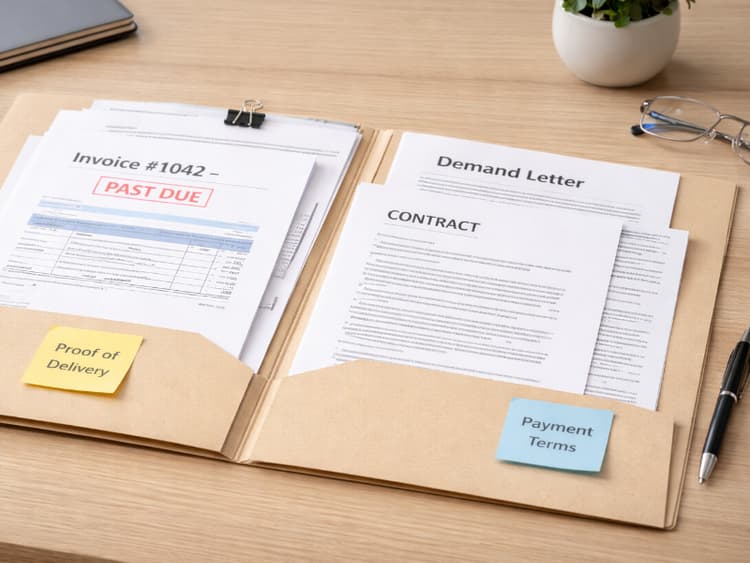
To prepare, organize:
- Signed contract or written agreement
- Copy of the invoice
- Proof the invoice was delivered
- Record of follow-up emails
- Copy of your demand letter
- Evidence that work was completed
Documentation is your leverage. Without it, your case becomes a verbal dispute.
This is also why structuring payment terms correctly from the beginning matters. If you need to tighten your payment terms going forward, see Invoice Payment Terms Explained.
Step 4: Evaluate Collection Agencies
Another option is hiring a debt collection agency.
Collection rules can also depend on who is collecting and what kind of debt is involved. In the United States, the CFPB explains federal consumer debt-collection rules and documentation requirements; a business invoice may fall outside some consumer protections, so confirm the rules for your situation. (CFPB debt collection resources)
Pros:
- They handle communication and enforcement
- You avoid court preparation
Cons:
- They take a percentage of the recovered amount
- The relationship with the client is likely over
- Recovery is not guaranteed
This path is best used when you have already written off the relationship and simply want partial recovery.
Step 5: Check Your Contract First
If the project was cancelled or paused mid-execution, your first line of defense may not be court. It may be your contract.
If you included a cancellation clause or kill fee provision, enforce that before escalating.
Review The Kill Fee: How to Invoice for Cancelled Projects.
Strong contracts reduce the need for legal action in the first place.
How to Reduce the Need for Legal Action
If you find yourself frequently considering court, the issue is usually structural.
Here is how to lower your risk long term:
Require Upfront Deposits
See Upfront Deposits: Why Freelancers Should Never Work for $0 Down.
Follow a Structured Reminder Timeline
See When to Follow Up on an Invoice.
Automate Documentation and Reminders
Manual spreadsheets create gaps. Systems create records.
Treat It as a Business Matter
Taking legal action over an unpaid invoice is not about revenge. It is about enforcing a business agreement.
Sometimes the correct decision is to pursue recovery through Small Claims Court. Other times, the smarter move is to tighten your systems so it never happens again. And sometimes, the most practical choice is to write off the invoice, document the decision, and move on.
The strongest freelancers are not the most aggressive. They are the most structured.
If your invoicing workflow does not automatically track reminders, document communication, and enforce terms consistently, you are relying on memory instead of process.
BillerBear helps freelancers keep invoice details and due dates clear, preserve PDF records, and automate payment reminders. That documentation is useful long before you consider formal escalation.
Ready to create clearer invoices?
Create up to 3 invoices per month free. No credit card required.
BillerBear Editorial
Continue reading
Freelance Statement of Work: How to Define Scope, Deliverables, and Payment Triggers Before You Invoice
A freelance statement of work turns vague agreements into defensible invoices. Here's what to include, how to structure payment triggers, and the mistakes that cost freelancers money.
Freelance Retainer Agreements: How to Structure Scope, Hours, and Invoicing
A retainer without structure is a discount. Learn how to define scope, set hours and rollover policies, handle overages, and invoice retainer clients so the arrangement works for both sides.
Freelance Contracts That Actually Protect Payment: 5 Clauses You Need
A freelance contract is not just paperwork — it's leverage. Here are the five essential clauses that protect your cash flow, prevent disputes, and ensure you get paid on time.