

For many freelancers, a contract feels like a formality. Something you send because you are supposed to. But a contract is not paperwork. It is leverage.
If your agreement is vague about money, you are operating on a handshake deal. And handshake deals fail the moment payment is delayed or a project is cancelled.
A strong freelance contract does not just describe the work. It protects the revenue.
Here are the five clauses that turn a basic agreement into a system that protects your cash flow.
1. The Upfront Deposit Clause
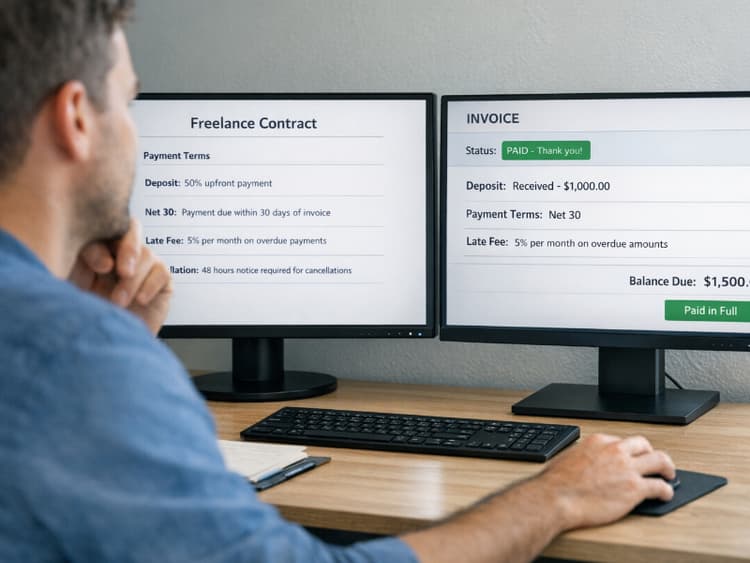
The most effective way to reduce non-payment risk is to require partial payment before work begins.
Your agreement should clearly state:
Work will commence only after a non-refundable deposit of [X]% has been received and cleared.
This does three important things:
- Filters out high-risk clients
- Confirms real budget approval
- Covers your initial production time
Clients who resist deposits often create payment issues later. Deposits align incentives from day one.
If you want to go deeper on how to position deposits professionally, see Upfront Deposits: Why Freelancers Should Never Work for $0 Down.
2. Specific Late Fee and Interest Terms
You cannot legally or professionally charge a late fee if it was not disclosed in your original agreement.
A strong clause includes:
- The exact due date structure such as Net 15 or Net 30
- The grace period length
- The penalty amount, percentage or flat fee
- Whether the fee accrues monthly
For example:
A late fee of 5% will apply to invoices 7 days past due.
Clarity removes emotion from enforcement. When payment is late, you are not "charging" someone. You are applying an agreed policy. If you plan to offer early-payment discounts (e.g., 2/10 Net 30), include those terms in the contract as well so they are enforceable. See Early Payment Discounts for Freelancers for how to structure them.
For timing strategy, reference How Long Should You Wait Before Charging a Late Fee?.
3. The Cancellation or Kill Fee Clause
Projects get paused. Budgets shift. Teams restructure.
Without a cancellation clause, you absorb that risk entirely.
Your contract should state that if the client cancels the project, they owe:
- Payment for work completed
- A defined cancellation fee
- Or a percentage of the remaining balance
This protects your calendar time, not just your labor.
To understand how this works in practice, see The Kill Fee: How to Invoice for Cancelled Projects.
4. Transfer of Ownership Upon Final Payment
This clause is one of the strongest protections available to freelancers.
Your agreement should clearly state:
Ownership of final deliverables transfers only after full and final payment has been received.
Until payment is complete, the client does not legally own the work.
If a client attempts to use unpaid deliverables, they are violating the agreement. This gives you leverage during an unpaid invoice recovery process.
This clause also strengthens your position if a client files a chargeback or payment dispute through their bank or processor. A signed agreement with clear ownership terms is exactly the kind of evidence platforms ask for. See Freelancer Chargebacks: What to Do When a Client Reverses a Payment.
If you are currently dealing with silence or avoidance, you may also want to review Client Won't Pay? An Escalation Plan for Freelancers.
Back up your contract with clean invoicing.
BillerBear keeps line items and due dates visible on every invoice so your contract and billing stay aligned.
Create a free invoice →5. Defined Scope and Change Order Process
Many payment disputes start with scope creep, not bad intentions.
If your scope is vague, your invoice will feel unexpected.
Your contract should define:
- Exact deliverables
- Number of revision rounds included
- Clear pricing for additional work
- A written change order requirement for out-of-scope tasks
For example:
Any work outside the defined scope will be billed at [rate] and must be approved in writing before execution.
This prevents the "I thought that was included" conversation that often leads to delayed payments.
For billing clarity strategies, see Scope Creep: How to Bill for "Just One Small Change". To define scope and deliverables in a standalone document, see Freelance Statement of Work. When a change actually happens mid-project, see Freelance Change Order Template for how to document, approve, and invoice it.
How to Get Contracts Signed Without Friction
Protection does not require complexity.
To reduce resistance:
- Use plain language
- Avoid unnecessary legal jargon
- Use digital signature tools
- Reference payment terms directly inside your invoices
When your contract and invoicing system reflect the same terms, you remove ambiguity.
If your payment terms themselves need tightening, review Invoice Payment Terms Explained. And if you want the full onboarding workflow that makes sure contracts, terms, and deposits are confirmed before work starts, see Freelance Client Onboarding Checklist.
Contracts Build Respect
Freelancers with vague agreements rely on goodwill.
Freelancers with structured agreements rely on process.
The difference shows up when payments are delayed.
A strong contract does not intimidate serious clients. It reassures them. It communicates professionalism and stability.
If your agreement does not clearly define deposits, late fees, cancellation terms, ownership transfer, and scope boundaries, you are carrying unnecessary risk.
Risk compounds over time.
Final Thought
Your contract sets the rule. Your invoicing workflow enforces it.
When those two systems work together, you reduce late payments, prevent disputes, and eliminate most escalation scenarios before they begin.
If you want clean invoices, automated reminders, and a consistent paper trail to back your contracts, BillerBear was built for exactly that.
Structure creates leverage. Leverage protects revenue.
Ready to create clearer invoices?
Create up to 3 invoices per month free. No credit card required.
BillerBear Editorial
Continue reading
Freelance Statement of Work: How to Define Scope, Deliverables, and Payment Triggers Before You Invoice
A freelance statement of work turns vague agreements into defensible invoices. Here's what to include, how to structure payment triggers, and the mistakes that cost freelancers money.
Freelance Retainer Agreements: How to Structure Scope, Hours, and Invoicing
A retainer without structure is a discount. Learn how to define scope, set hours and rollover policies, handle overages, and invoice retainer clients so the arrangement works for both sides.
Can You Take Legal Action Over an Unpaid Invoice? A Practical Guide
When polite follow-ups fail and an invoice stays unpaid, is legal action the right move? This practical guide covers demand letters, small claims court, and collection options for freelancers.