
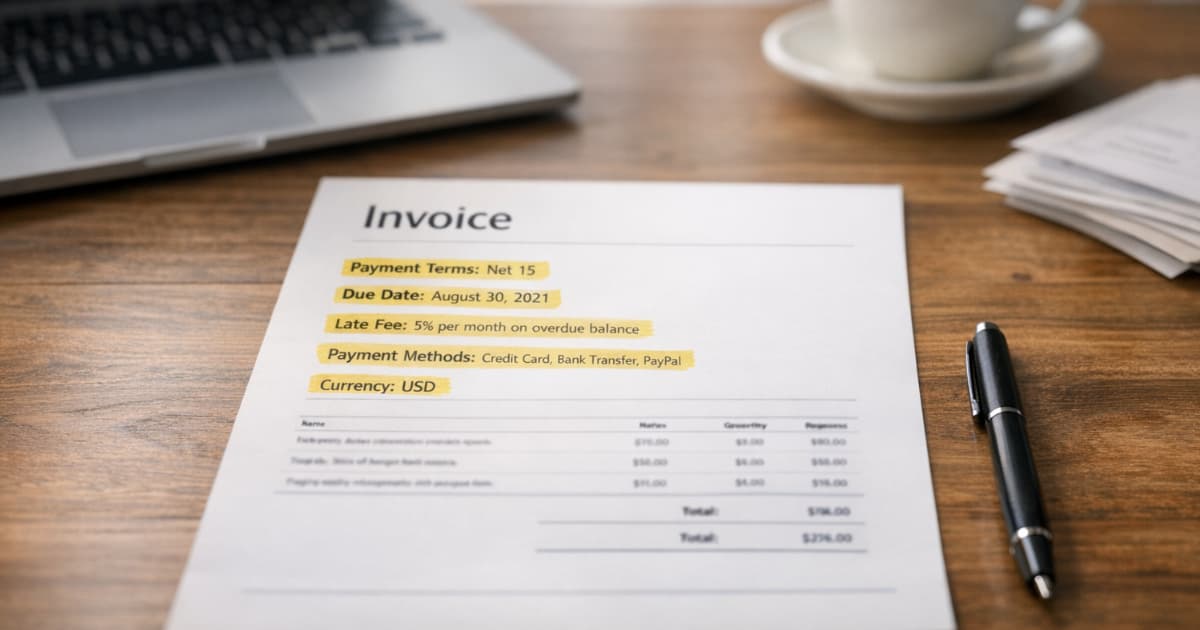
An invoice is not just a request for payment. It is a financial agreement in action.
If your payment terms are vague, you are unintentionally signaling that your deadline is flexible. And flexible deadlines are the fastest path to delayed payments.
Late payments often do not start with bad intentions. They start with ambiguity. When clients are unsure about due dates, payment methods, or approval processes, your invoice becomes the easiest bill to postpone.
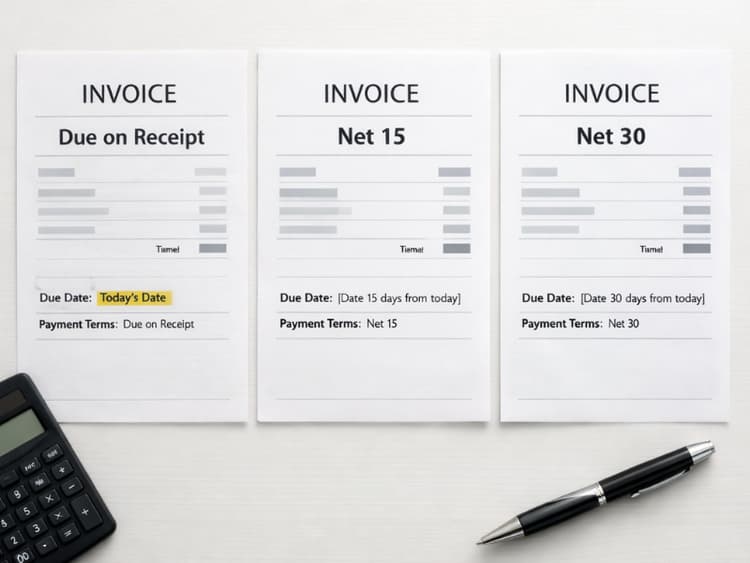
Clear payment terms remove friction before it begins. This guide focuses on how to write and apply the clause. If you need definitions of Due on Receipt, Net 7, Net 15, or Net 30, start with Invoice Payment Terms Explained.
1. Move Beyond Net 30 by Default
Many freelancers use Net 30 because it feels standard. But Net 30 means you are extending 30 days of interest-free credit.
If you want to improve cash flow, consider tighter structures:
Due on Receipt
Best for new clients, short projects, or final milestone payments.
Net 15
A professional middle ground. It allows processing time without extending unnecessary risk.
Milestone Billing
Break large projects into payment stages. For example, 50% upfront and 50% upon completion. This reduces the risk of non-payment at the end.
Shorter payment cycles reduce exposure and improve predictability.
2. Identify the Billing Contact Before Sending the Invoice
Payment delays are often administrative, not intentional.
Before sending your invoice, confirm:
- The exact person responsible for accounts payable
- Whether a Purchase Order number is required
- The preferred submission format
- The approved payment method
If a company requires a PO and you omit it, your invoice may sit unprocessed for weeks.
To understand how POs fit into professional workflows, see Invoice vs. Receipt vs. Purchase Order: What's the Difference?. For the full corporate AP process, including vendor onboarding, portals, and payment runs, see How to Invoice Corporate Clients.
Clarity at onboarding prevents confusion at payment time.
3. Specify Accepted Payment Methods Clearly
Do not assume clients know how to pay you.
Your invoice should list:
- The bank-transfer details or payment link the client needs
- Accepted payment methods
- Any processing fees the client is responsible for
- The exact currency
If you work internationally, clearly state the currency. For example:
All payments must be made in USD.
Ambiguity around currency or fees creates unnecessary disputes.
4. Use Incentives Strategically
Late fees protect you. Incentives can accelerate you.
An early payment discount is one option. For example:
2% discount if paid within 7 days.
This gives accounting departments a reason to prioritize your invoice over others.
If you implement both incentives and penalties, make sure they are clearly written and consistent with your contract. For a deeper look at whether early-pay discounts actually make financial sense and how to calculate the real cost, see Early Payment Discounts for Freelancers: Is 2/10 Net 30 Worth It?.
For enforcement strategy, reference How Long Should You Wait Before Charging a Late Fee?.
Consistency builds credibility.
Keep the agreed due date visible.
BillerBear puts the due date on every invoice and sends automated reminders when payment is due and overdue.
Create a free invoice →5. Standardize Your Late Fee Language
A late-fee clause should be disclosed before the invoice becomes overdue, but disclosure alone does not guarantee enforceability. Rules vary by jurisdiction, customer type, contract, and fee amount. Verify the terms that apply to your business.
Your invoice and your contract should match.
For example, after obtaining appropriate local advice:
[Describe the agreed fee or interest calculation] applies to balances unpaid after [grace period], subject to applicable law.
This removes surprise and turns enforcement into policy.
If you have not yet structured this properly, also review Freelance Contracts That Actually Protect Payment: 5 Clauses You Need.
Your agreement sets the rule. Your invoice repeats it. As a jurisdiction-specific example, the UK publishes statutory rules for interest on some late commercial payments; those rules should not be treated as a universal template. (GOV.UK late commercial payments guidance)
6. Be Explicit About Transfer of Ownership
Payment terms are stronger when tied to ownership.
If your contract and local law support it, consider a statement such as:
Ownership of final deliverables transfers only upon receipt of full payment.
This can reinforce that payment is part of the completion process. Ownership and intellectual-property rules vary, so have the clause reviewed for your work and location rather than relying on invoice wording alone.
If you are dealing with unpaid invoices already, see Client Won't Pay? An Escalation Plan for Freelancers.
Prevention is easier than recovery.
A Copyable Payment Terms Block
- Payment terms: Net 15
- Invoice date: September 1, 2026
- Due date: September 16, 2026
- Currency: USD
- Payment method: [bank transfer or configured payment link]
- Payment reference: Include Invoice #1042
- Questions: Contact [billing email] before the due date
Add only clauses that were agreed and are valid for your situation. If there is a late fee, discount, purchase-order requirement, or ownership condition, state the exact rule in the contract and repeat it here without changing the meaning.
Automate Enforcement
Even perfectly written payment terms fail if you do not enforce them consistently.
Manual tracking leads to missed deadlines and emotional follow-ups. A structured invoicing workflow supports:
- Automatic payment reminders
- Consistent documentation on every invoice
- Clear records for follow-up when needed
That consistency protects your time and your revenue.
Final Thought
Payment terms are not just administrative details. They are risk management tools.
Shorter cycles, clear contacts, defined methods, and consistent enforcement create predictable cash flow. To see how your payment terms translate into actual cash timing across clients, see Freelance Cash Flow Forecasting: A 90-Day Plan for Uneven Income. And to monitor whether clients are actually respecting your terms week to week, see Accounts Receivable for Freelancers.
If your current invoicing process relies on memory and manual follow-ups, you are creating unnecessary exposure.
A structured system keeps the agreed due date visible and makes follow-up easier.
BillerBear helps freelancers keep due dates visible, send scheduled reminders, and maintain a professional record of every invoice. Add any contractual payment language to the documents and fields available in your own workflow; BillerBear does not currently provide a dedicated editable payment-terms field.
Clarity prevents delay. Structure prevents loss.
Ready to create clearer invoices?
Create up to 3 invoices per month free. No credit card required.
BillerBear Editorial
Continue reading
Invoice Line Item Descriptions: Examples and a Copyable Formula
Use a practical invoice line-item formula, before-and-after examples by service type, and wording that matches the scope your client approved.
What Business Name Goes on a Freelance Invoice? LLC, DBA, and Legal Name Explained
Not sure whether to invoice under your legal name, LLC, or DBA? Learn what belongs in your invoice header, how it should connect to your W-9, and how to prevent vendor setup and AP delays.
When to Send an Invoice as a Freelancer: Timing Rules by Project Type
Learn when freelancers should send project, hourly, milestone, retainer, and corporate invoices, and avoid delays before payment terms even begin.