

You followed up. You sent a demand letter. You weighed legal options. The client still is not paying.
At some point, the hours you spend chasing the debt are worth more than the invoice itself. That is when a write-off becomes the right call.
Writing off an invoice is not the same as deleting it. You need records, tax awareness, and a clean close in your books. A few common mistakes here can cause problems later.
This guide covers when to stop chasing, how to close the invoice properly, and what it means for your taxes.
Disclaimer: This article is for educational purposes only and does not constitute legal or tax advice. Laws and tax rules vary by jurisdiction. Consult a qualified accountant or attorney for guidance specific to your situation.
When to Write Off an Unpaid Invoice
Not every overdue invoice should be written off. A write-off is the endpoint after every other option has been exhausted or rejected.
Before closing the books on an invoice, make sure you have:
- Exhausted your follow-up sequence. Multiple reminders, firm final notices, and a reasonable waiting period. If you have not done this, start with How to Politely Ask for Payment.
- Sent a formal demand letter. This is the step between polite follow-ups and legal action. If you skipped it, see How to Write a Demand Letter for an Unpaid Invoice.
- Evaluated legal action. Small claims court, mediation, or a collection agency. If you have not done this cost-benefit analysis, review Can You Take Legal Action Over an Unpaid Invoice?.
Once you have worked through those steps, ask yourself three questions:
Is the amount worth the remaining effort? Many collection agencies work on contingency and charge a percentage of whatever they recover, often in the 20% to 50% range depending on debt age and size. Small claims filing fees vary by state and claim amount. If the invoice is $300 and the realistic recovery cost (time, fees, stress) exceeds that, the math favors a write-off.
Is the client still reachable and operating? If the client's business has closed, moved without forwarding information, or gone through bankruptcy, a judgment may be unenforceable. Recovery from a defunct entity is rarely worth pursuing.
Have you hit the practical ceiling of escalation? If a demand letter went unanswered and legal action is disproportionate to the amount, you have reached the end of the line. Continuing to chase it is not persistence. It is sunk cost.
How to Close the Invoice in Your Records
Writing off an invoice is a documentation event, not a deletion. The goal is to preserve the invoice, its payment history, reminders sent, and any notes so the record stays clean even when the debt is no longer worth chasing.
Do Not Delete the Invoice
Deleting an invoice creates a gap in your records and your invoice numbering sequence. Keep the original invoice on file. Change its status to reflect that it is uncollectible.
Mark It as Written Off
If your invoicing tool supports custom statuses, mark the invoice as "written off" or "uncollectible." If it does not, add a dated note to the invoice record explaining the decision.
A simple internal note looks like this:
Written off on [date]. Client unresponsive after demand letter sent [date]. Amount: $[X]. Decision: recovery cost exceeds invoice value. No further action.
Keep the Supporting Paper Trail
Save everything connected to this invoice:
- The original invoice PDF
- Your contract or written agreement
- Proof that work was delivered
- Follow-up emails and their dates
- The demand letter and any delivery confirmation
- Notes on why you decided to stop pursuing
This documentation matters if the client reappears, if you need records for taxes, or if you spot the same red flags with a future client and want a reference point.
Keep your invoice records clean.
BillerBear tracks every invoice from draft through paid or overdue, so your records are in order when you need to close the books.
Create a free invoice →Write-Off vs. Void vs. Credit Note
These three terms get confused often. They serve different purposes.
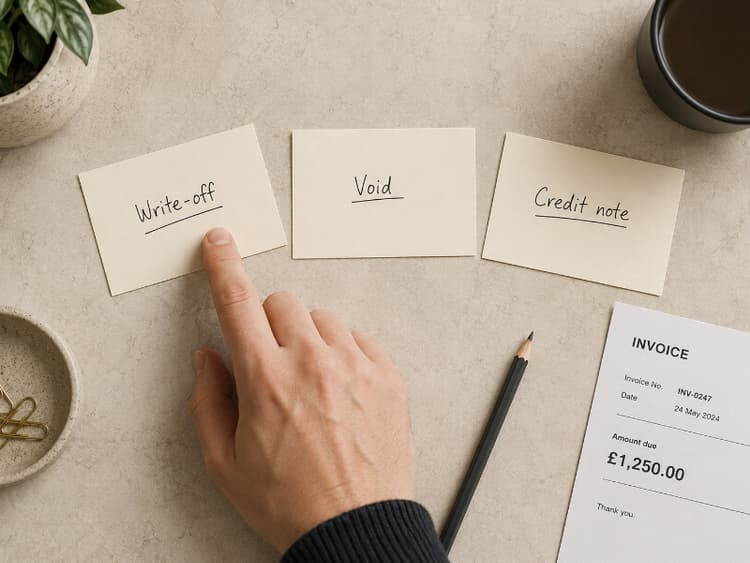
Write-off: You delivered the work. The client owes you money. You are closing the invoice because collection is no longer worth pursuing. The invoice stays in your records as uncollectible.
Void: The invoice should never have existed. Maybe you sent it to the wrong client, duplicated it, or the project was cancelled before any work began. Voiding removes the invoice from your active records without affecting your income history. For more on correcting invoices, see How to Correct an Invoice After Sending.
Credit note: You issued an invoice, the client paid (or partially paid), and then you need to adjust the balance. Credit notes reduce what the client owes because of a pricing error, returned work, or negotiated discount.
The distinction matters for your books. A write-off does not erase the work you did or the invoice you issued. It marks the debt as uncollectible.
What a Write-Off Means for U.S. Freelancer Taxes
This is where freelancers get confused, and where the difference between cash-basis and accrual-basis accounting matters.
Cash Basis (Most Freelancers)
Most sole-proprietor freelancers use the cash method for tax purposes. On cash-basis accounting, you report income when you receive payment, not when you send the invoice.
That means an unpaid invoice was never counted as taxable income. There is nothing to deduct because there was nothing to reverse. For cash-basis freelancers, a write-off is a business and bookkeeping decision, not a tax event.
You still lose the time and effort you put into the work. But there is no separate "bad debt deduction" to claim on Schedule C for an invoice that was never recorded as income.
Accrual Basis (Less Common for Freelancers)
Freelancers who use accrual-basis accounting report income when it is earned, even before payment arrives. If you previously included the invoice amount in gross income and the debt becomes uncollectible, you may be able to deduct it as a business bad debt.
The IRS requires that you show the debt is worthless (or partially worthless) and that you made reasonable efforts to collect. Documentation of your follow-ups, demand letter, and the decision to stop pursuing matters here.
Either Way, Talk to Your CPA
Tax treatment of bad debt depends on your accounting method, your state's rules, and the specifics of the situation. Before claiming any deduction, confirm with a qualified accountant. This is especially important if you are on the accrual method, if the amount is large, or if you have already filed a return that included the unpaid amount as income.
For general tax organization, see The Freelancer Tax Prep Checklist.
Common Mistakes When Writing Off Invoices
Deleting Instead of Documenting
Deleting an invoice feels like closure, but it removes evidence you may need later. Always keep the original record.
Writing Off Too Early
If you have only sent two emails and waited a week, that is not a write-off situation. It is a follow-up situation. Work through the escalation plan before jumping to write-off.
Assuming a Write-Off Is Always a Tax Deduction
Cash-basis freelancers cannot deduct unpaid invoices because the income was never reported. Do not file a bad debt deduction you are not entitled to.
Failing to Update Your Systems
If you use automated payment reminders, turn them off for written-off invoices. Sending reminders to a client you have already decided to stop pursuing wastes time and can damage your professional reputation.
Not Learning from It
Every uncollectible invoice teaches you something. Was there a red flag you missed during onboarding? Did the contract lack a deposit clause? Would upfront deposits have limited your exposure?
Use the experience to tighten your process for the next client.
What If the Client Pays Later?
It happens. A client goes silent for months, you write the invoice off, and then a payment shows up.
Do not create a new invoice. Reopen or update the original invoice record, mark the payment as received, and keep the write-off note in the history so your records reflect what actually happened. If the client pays only part of what was owed, record the partial payment and leave the remaining balance documented.
If you previously claimed a bad debt deduction (accrual-basis filers), talk to your accountant about how to treat the recovery on your next return. For cash-basis freelancers, the payment is simply income in the year you receive it.
Move On with Clean Records
Writing off an invoice is not a failure. It is a business decision: the cost of continued pursuit exceeds the value of recovery.
Keep the invoice, save the paper trail, update your records, and turn off reminders so nothing keeps firing at a dead account.
Ready to create clearer invoices?
Create up to 3 invoices per month free. No credit card required.
BillerBear Editorial
Continue reading
Client Says They Paid Your Invoice but You Haven't Received It: What to Do Next
When a client insists they've paid but your bank shows nothing, don't argue and don't mark it paid. Here's a verification-first workflow to diagnose the gap and resolve it.
How to Set Up an Invoice Payment Plan That Protects Your Cash Flow
When a client can't pay the full invoice at once, a structured payment plan can recover the revenue. Here's how to decide when a plan makes sense, what to put in writing, and how to invoice each installment.
Net 60 Payment Terms? How to Negotiate Faster Payment as a Freelancer
When a corporate client sends a vendor agreement with Net 45 or Net 60, you don't have to accept it as-is. Counter-offers, scripts, and what AP teams sometimes accept.