

It's a familiar freelance pattern: the project moves forward, the work gets delivered, and the final invoice sits unpaid while the client asks for "just a few more revisions." Weeks pass. The full fee is suddenly in question.
That's what happens when a project has one payment point at the end. All the risk sits with you.
Milestone billing changes that. Instead of a single invoice after delivery, you break the project into phases with payments attached to each one. You get paid as you work; the client approves progress along the way. If the client's finance team needs a full project preview before approving the first milestone, a proforma invoice can serve that role. See Proforma Invoice for Freelancers.
Here's how to set it up so it actually works.
What Milestone Billing Is (and Is Not)
Milestone billing ties payments to specific project stages instead of a single delivery date. Each milestone is a defined chunk of work with a corresponding invoice.
It's different from:
- Hourly billing: you invoice based on time tracked
- Flat rate with one payment: you deliver everything and bill once (see Hourly vs. Flat Rate Invoicing for how to choose between these and itemize each)
- Retainers: a client pays a recurring fee for ongoing availability
Milestone billing sits between these models. It gives the client visibility into progress and gives you cash flow throughout the project instead of only at the end.
The core idea is simple: no major phase starts without the previous payment clearing.
If you're handling multiple payments against a single invoice rather than separate invoices per phase, see Partial Payments on Invoices.
Common Milestone Structures
There's no universal formula. The right structure depends on project length, complexity, and how much trust exists between you and the client.
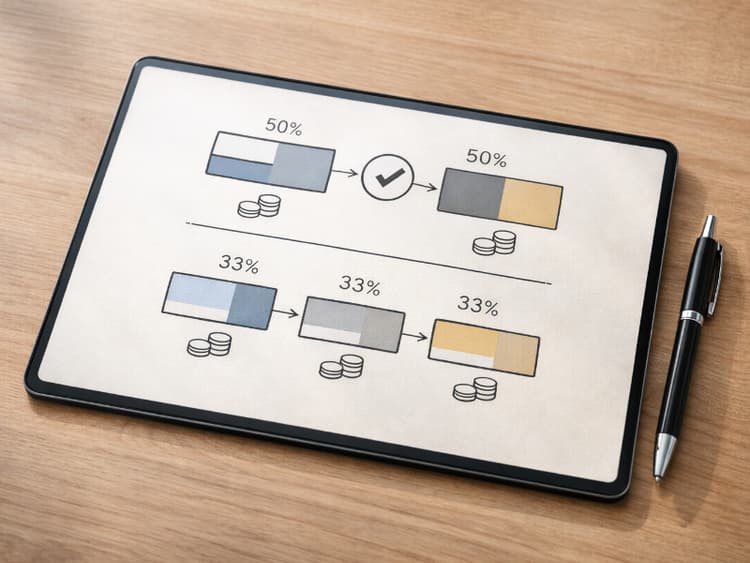
50/50
- 50% before work begins
- 50% on final delivery
Best for: short-to-medium projects with a clear deliverable. It's the simplest structure and often works well for projects under four weeks.
33/33/33
- 33% upfront
- 33% at the midpoint
- 33% on delivery
Best for: medium-length projects with a natural halfway point. For example, a branding project where discovery, design, and final assets each represent a distinct phase.
25/25/25/25
- 25% upfront
- 25% after phase one
- 25% after phase two
- 25% on final delivery
Best for: longer projects spanning two or more months, especially when multiple deliverables are involved. Each payment is tied to a defined phase.
Custom Milestones Tied to Deliverables
Sometimes percentages don't reflect the actual work distribution. In those cases, tie payments directly to specific deliverables:
- Discovery and strategy document — $X
- First draft or prototype — $X
- Revisions and final delivery — $X
This works well for creative, development, and consulting projects where phases have different levels of effort.
How to Choose the Right Structure
Start with these questions:
- How long is the project? For anything over two weeks, at least two payment points beat one.
- New client or repeat? New clients get tighter milestone structures. Repeat clients with good payment history may need fewer checkpoints.
- Are there natural deliverable stages? If the project has clear phases (research, draft, final), tie payments to each one.
- How much financial risk are you carrying? If you're investing significant time before any payment, the structure needs to change.
A useful default: if you're unsure, start with 50/50 for small projects and 33/33/33 for anything larger. Adjust from there.
For guidance on deposit sizing, see Upfront Deposits: Why Freelancers Should Never Work for $0 Down.
Tying Milestones to Deliverables, Not Dates
A common mistake is tying payments to calendar dates instead of deliverables.
If you write "second payment due April 15" but the project timeline shifts, you get a mismatch between work completed and payment expected.
Define milestones as deliverable-based triggers instead:
Second payment of $X is due upon approval of the wireframe deliverable.
That keeps payment aligned with progress. The client pays when they receive something. You invoice when you complete something.
It also protects you if the client causes delays. If they take three weeks to provide feedback, your milestone payment still triggers when the deliverable is approved, not on a fixed date that's already passed. A freelance statement of work is where those milestones, deliverables, and payment triggers get formally defined.
Writing Milestone Terms Into Your Contract
Milestone billing only works if it's documented. Verbal agreements about payment schedules create the same problems as no agreement at all.
Your contract should include:
- The total project fee
- The number of milestones
- What each milestone covers (specific deliverables)
- The payment amount for each milestone
- When each payment is due (on delivery, on approval, or within X days)
- What happens if the client delays approval
Example contract language:
The total project fee is $6,000, structured as follows:
- Milestone 1: $2,000 — due before work begins (deposit)
- Milestone 2: $2,000 — due upon delivery of first draft
- Milestone 3: $2,000 — due upon delivery of final assets Each milestone payment is due within 7 days of the deliverable being submitted. Work on the next phase will not begin until the previous milestone payment has been received.
That last line is critical. It creates a built-in pause if payment stalls, protecting your time without requiring a confrontation.
For broader contract protection, see Freelance Contracts That Actually Protect Payment: 5 Clauses You Need.

Send a separate invoice for each milestone.
BillerBear lets you create milestone invoices with their own due dates, payment links, and automated reminders.
Create a free invoice →How to Invoice Each Milestone
Before your first milestone invoice, make sure you have an accepted quote or agreement that defines the milestones and amounts. If you're not sure how quotes and invoices connect, see Freelance Quote vs Invoice.
Each milestone gets its own invoice. Don't combine milestones into a single invoice with a running balance. That creates confusion about what's owed and when.
For each milestone invoice, include:
- A clear reference to the milestone number and project name
- The specific deliverable being billed
- The amount for that milestone
- Payment terms (e.g., Net 7, Due on Receipt)
- A note referencing the original agreement
Example invoice line item:
Milestone 2 of 3 — Brand Guidelines Document Per agreement dated [date]. Deliverable submitted [date]. Amount: $2,000 Due: Net 7
That connects each invoice to the contract, reduces disputes, and gives the client a clear record of what they're paying for.
For invoicing fundamentals, see How to Create a Professional Invoice. For when exactly to send each milestone invoice (submission vs. approval triggers, deemed-approval clauses), see When to Send an Invoice as a Freelancer.
For payment term options, see Invoice Payment Terms Explained.
For what to write in the email when you send each milestone invoice, see How to Email an Invoice to a Client.
If scope changes mid-project and affects a milestone total, document the change with a written change order before adjusting the invoice. See Freelance Change Order Template for the approval process and how to reference the CO on the invoice.
What to Do When a Milestone Payment Is Late
Late milestone payments are a signal. They may mean cash flow issues, internal approval delays, or declining commitment.
Your response depends on the situation:
First late payment
Send a polite follow-up referencing the contract terms. Often, a simple reminder resolves it.
Repeated delays
Pause work on the next phase until payment is received. Your contract should already support this: "work on the next phase will not begin until the previous milestone payment has been received."
Non-payment after multiple follow-ups
Escalate. The milestone structure helps here: you have documented deliverables, clear payment schedules, and a paper trail showing what was completed and when.
For a step-by-step escalation process, see Client Won't Pay? A Freelancer's Escalation Plan.
If the client has disappeared entirely, see What to Do When a Client Ghosts You.
When Not to Use Milestone Billing
Milestone billing isn't the right fit for every situation:
- Ongoing retainer work: use recurring invoices instead
- Very small projects under a few hundred dollars: a single upfront payment is simpler
- Hourly work with fluctuating scope: time-based billing with regular invoicing cycles works better. If the scope is still moving and the actual workload is hard to predict, milestone billing can create arguments about whether a phase is really "done."
For retainer and recurring billing, see Recurring Invoices: How to Set Up Automatic Billing.
Milestone Billing Protects Both Sides
Clients sometimes resist milestone billing because they assume it only benefits the freelancer. It actually protects both parties:
- For the freelancer: steady cash flow, reduced non-payment risk, built-in pause mechanism
- For the client: visibility into progress, approval checkpoints, lower risk of paying for unfinished work
Milestone billing turns a large, ambiguous payment into a series of smaller, verifiable transactions. Both sides know where the project stands at every point.
Structure Your Payments Like You Structure Your Projects
If your projects have phases, your billing should have phases too.
Milestone billing isn't a negotiation tactic. It's a professional structure that reduces risk, improves cash flow, and gives both sides clarity throughout the project.
Define the milestones. Write them into the contract. Invoice each one separately. Pause if payment stalls.
When your project structure and payment structure match, disputes become less common and cash flow becomes predictable. For a broader look at forecasting your cash flow across all clients and projects, see Freelance Cash Flow Forecasting: A 90-Day Plan for Uneven Income.
When the final milestone wraps, Freelance Project Closeout Checklist covers the acceptance, handoff, and final invoice steps.
Ready to create clearer invoices?
Create up to 3 invoices per month free. No credit card required.
BillerBear Editorial
Continue reading
Invoice Line Item Descriptions: Examples and a Copyable Formula
Use a practical invoice line-item formula, before-and-after examples by service type, and wording that matches the scope your client approved.
What Business Name Goes on a Freelance Invoice? LLC, DBA, and Legal Name Explained
Not sure whether to invoice under your legal name, LLC, or DBA? Learn what belongs in your invoice header, how it should connect to your W-9, and how to prevent vendor setup and AP delays.
When to Send an Invoice as a Freelancer: Timing Rules by Project Type
Learn when freelancers should send project, hourly, milestone, retainer, and corporate invoices, and avoid delays before payment terms even begin.