

The "From" block on your invoice is one of the first things a client's accounts payable (AP) team checks. If you operate as a sole proprietor, the answer is usually straightforward. Add an LLC, a DBA, or a brand name clients know you by, and the right choice gets less obvious.
Should you use your legal name? The LLC's name? Your DBA?
Getting the business name wrong on your invoice is rarely a legal disaster on its own, but it is often a cause of payment delays.
Here's what usually works for the business name on your freelance invoice, based on how you're set up.
This guide assumes you are a U.S. person who provides clients with Form W-9. This article is for general information only and is not tax or legal advice. Entity naming and DBA rules vary by state; confirm your setup with a qualified professional if you're unsure.
The Golden Rule of Invoice Names
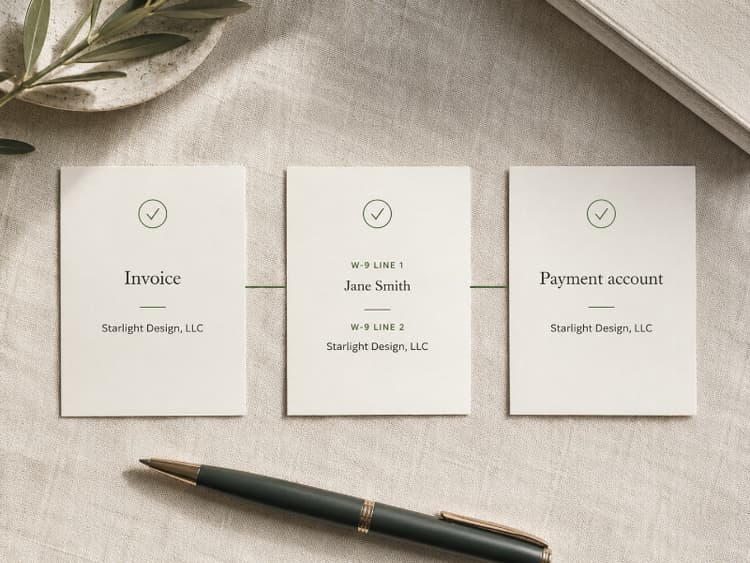
Your invoice, W-9, contract, and payment details should tell a consistent story about who provided the services, who is being paid, and whose tax information is being reported—even when the names are not identical.
For example, a single-member LLC may invoice and contract under the LLC's legal name while its W-9 lists the owner's name on Line 1 and the LLC's name on Line 2. What matters is that the relationship between those names is clear in the client's vendor records.
Before sending your first invoice, make sure:
- The invoicing entity matches the party named in the contract.
- The client has a current W-9 showing the correct tax name and TIN.
- Any LLC, DBA, or personal name used on the invoice can be connected to the names on the W-9.
- The payment instructions use a payee name accepted by your bank or payment provider.
If AP sees an invoice from "Starlight Design" but the W-9 and contract say "Jane Smith," AP may pause the invoice or request clarification before releasing payment. Consistency helps prevent avoidable payment delays.
For more on setting up your vendor paperwork, see W-9 for Freelancers.
What to Use by Entity Type
Sole Proprietor (No Formal Entity)
If you operate the business by yourself and have not formed an LLC or corporation, you generally operate as a sole proprietor.
Invoice header: Use your full legal name.
You can add a descriptive line below your name if you want (e.g., Jane Smith / Freelance Writer). For federal tax reporting, your individual tax name goes on Line 1 of Form W-9. Any business, trade, or DBA name goes on Line 2.
Sole Proprietor with a DBA
If you registered a DBA or trade name where required in your state or county, you can invoice under that brand name as long as it ties back to your legal identity.
Invoice header: A common format is your legal name followed by the DBA.
Example: Jane Smith d/b/a Starlight Design
That gives AP a clear link between the brand they know, the tax name on your W-9, and the payee name used in your payment instructions. On the W-9, a sole proprietor normally enters the individual tax name on Line 1 and the DBA on Line 2.
Single-Member LLC
If you formed a single-member LLC, your invoice will usually identify the LLC as the business providing the services—especially when the contract is also with the LLC.
Invoice header: Use the LLC's full legal name, including the "LLC" designation.
Example: Starlight Design, LLC
Your W-9 depends on the LLC's federal tax classification:
- Disregarded entity: The owner's tax name goes on Line 1, and the LLC's name goes on Line 2. If the owner is an individual, the W-9 generally uses the owner's SSN or EIN—not the LLC's EIN—for income-tax reporting.
- LLC taxed as a C corporation or S corporation: The LLC's name goes on Line 1, and any separate DBA or trade name goes on Line 2.
Because the invoice and W-9 may legitimately show different primary names, make sure the client's vendor record connects the LLC to the owner or tax entity shown on the W-9.
If the contract is with the LLC, use the LLC as the primary invoicing entity. You may still include the owner's name as a contact or as additional identification when needed.
LLC with a DBA
If your LLC operates under a different trade name, include both.
Invoice header: The LLC's legal name, followed by the DBA.
Example: Starlight Design, LLC d/b/a Starlight Creative
The W-9 placement depends on whether the LLC is disregarded or taxed as a separate corporation or partnership.
Multi-Member LLC or LLC Taxed as a Corporation
A multi-member LLC is generally taxed as a partnership unless it has elected another classification. An LLC taxed as a partnership, C corporation, or S corporation normally enters the entity's tax name on Line 1 of the W-9 and any separate DBA on Line 2.
Invoice header: Use the entity's full legal name, including the LLC designation, followed by the DBA when applicable.
Set your business details once.
BillerBear saves your business name and address in your profile. Every new invoice starts with the right header.
Create a free invoice →Should You Put Your EIN on the Invoice?
Freelancers often wonder whether to print an Employer Identification Number (EIN) or Social Security Number (SSN) on the invoice itself.
Generally, no. Your invoice is a billing document, not a tax form. Your EIN or SSN should normally be provided through a W-9 or another secure onboarding process, not printed on every invoice. Putting a tax ID on a routine PDF that gets emailed around a client's office adds unnecessary exposure.
Some international clients may require a tax ID or other identifier for VAT/GST or local compliance. If you're invoicing across borders, confirm what they need before you send the first invoice. Otherwise, keep tax IDs off the invoice.
Common Invoice Name Mistakes
These mismatches show up often enough to slow payment:
- The undocumented entity change: You form an LLC or change your tax classification but do not update the client's vendor records. Forming a disregarded single-member LLC does not always change the name and TIN used for 1099 reporting, but your contract, invoice header, payment details, or W-9 may still need updating. Send clients a new W-9 whenever the applicable tax name or TIN changes, and explain any new LLC or DBA name before issuing invoices under it.
- The unclear payment name: You invoice under a DBA, but your payment instructions identify only your personal or LLC bank account. ACH payments may still post based on the account number, but banks, checks, wires, and payment platforms can apply different beneficiary-name rules. Use the payee name your financial institution accepts and make the connection between the DBA and legal account holder clear.
- Dropping the legal suffix: You write "Starlight Design" even though the registered entity is "Starlight Design, LLC." Using the complete legal entity name reduces ambiguity and helps the invoice match the client's vendor and contract records. See How to Invoice Corporate Clients for more on surviving strict AP reviews.
Keep Your Header Consistent
Once you settle on the correct business name for your invoices, use it every time. Changing it without notice confuses AP and can trigger extra AP review or vendor verification.
Ready to create clearer invoices?
Create up to 3 invoices per month free. No credit card required.
BillerBear Editorial
Continue reading
Invoice Line Item Descriptions: Examples and a Copyable Formula
Use a practical invoice line-item formula, before-and-after examples by service type, and wording that matches the scope your client approved.
When to Send an Invoice as a Freelancer: Timing Rules by Project Type
Learn when freelancers should send project, hourly, milestone, retainer, and corporate invoices, and avoid delays before payment terms even begin.
Proforma Invoice for Freelancers: What It Is, When to Send One, and What to Include
Client asked for a proforma invoice? Learn what it is, how it differs from a quote or final invoice, when freelancers need one, and exactly what to send.