
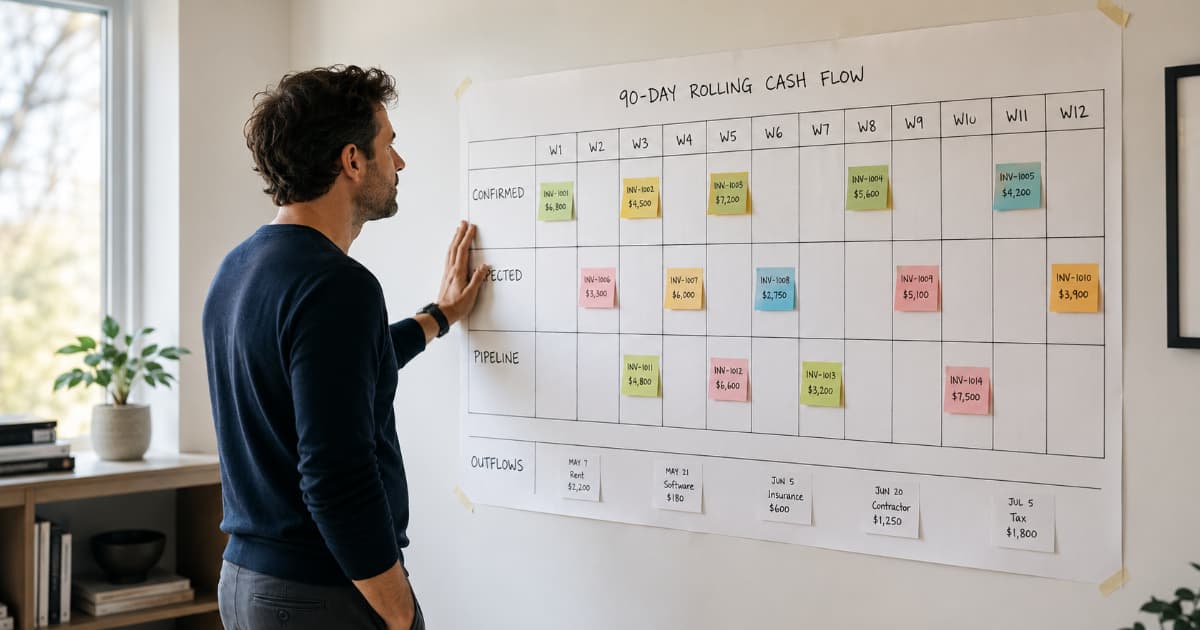
You had three strong months. Then a project ended, a Net 30 client paid on day 47, and a quarterly tax payment hit the same week. Your bank balance went from comfortable to concerning overnight.
The revenue was still there. The timing wasn't.
Freelancers get squeezed when they can't see what's coming. A 90-day cash flow forecast, built from the invoices you're already tracking, turns your pipeline into a week-by-week view of what's ahead.
Why Freelancers Need a Cash Flow Forecast
Salaried employees get paid on a predictable schedule. Freelancers don't. Your income depends on when clients pay, not when you invoice. A $6,000 invoice sent today might land in 14 days, 45 days, or not at all.
Your expenses don't wait. Rent, software subscriptions, quarterly estimated taxes, and contractor fees hit on fixed dates whether or not your pipeline is full.
A cash flow forecast won't predict the future perfectly. It shows the gap between when money comes in and when it goes out, far enough ahead that you can plan around it.
Build a 90-Day Rolling Forecast From Your Invoice Pipeline
You don't need financial modeling software. A spreadsheet, your invoice records, and about 45 minutes will do.
Step 1: List Your Expected Inflows
Start with money you're already expecting. Pull your current invoice pipeline and sort it into three categories:
Confirmed cash: Payments already received and invoices marked as paid but not yet deposited. If you have highly predictable recurring invoices scheduled within the next 90 days, include those here too, but weight them slightly lower than money already in hand. For how recurring invoices create predictable revenue, see Recurring Invoices: How to Set Up Automatic Billing.
Expected cash: Invoices you've sent but haven't been paid yet. Estimate when each will actually arrive based on the client's payment terms and history. A client who pays Net 30 invoices on day 28 is different from one who consistently stretches to day 50. If you're not sure what terms you're working with, see Invoice Payment Terms Explained. If you don't already have a clear picture of what's outstanding and how long each invoice has been sitting, start with a weekly AR review before building the forecast. See Accounts Receivable for Freelancers.
Pipeline cash: Work you've signed or started but haven't invoiced yet. This includes upcoming milestones, retainer payments, and deposits. It's the least certain category, but ignoring it makes your forecast too pessimistic. For structuring these, see Milestone Billing for Freelancers and Freelance Retainer Agreements.
Step 2: List Your Known Outflows
Write down everything you know you'll spend in the next 90 days:
- Rent or mortgage
- Software and tools
- Contractor or subcontractor payments
- Insurance premiums
- Quarterly estimated tax payments (see Quarterly Estimated Taxes for Freelancers for calculation guidance)
- Loan or credit payments
- Marketing or advertising costs
Skip variable personal expenses unless they're large and fixed. You're tracking business cash flow, not a full household budget.
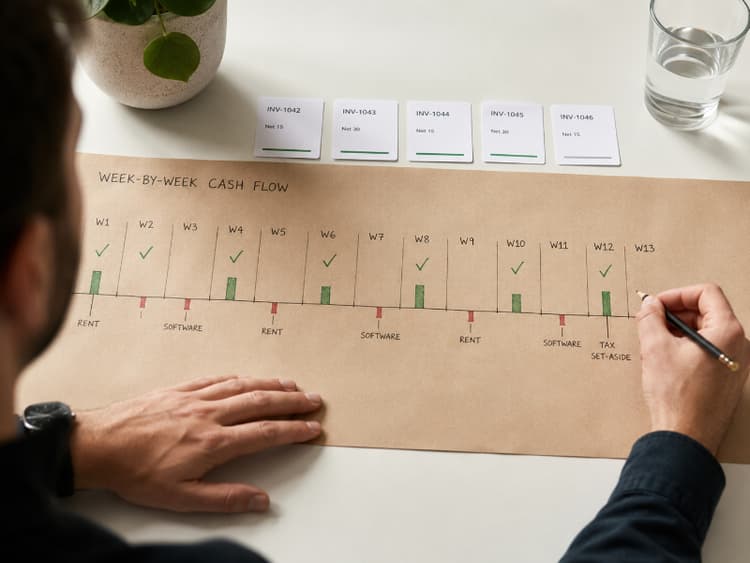
Step 3: Map It Week by Week
Lay out 12 or 13 weeks across the top of your spreadsheet. For each week, enter:
- Starting balance: Your actual bank balance (week 1) or the previous week's ending balance
- Inflows: Which invoices you expect to be paid that week, based on payment terms and client behavior
- Outflows: Which expenses are due
- Ending balance: Starting balance + inflows − outflows
Watch the ending balance. When it dips below your comfort threshold, that's the week to prepare for.
Say you start Week 1 with $4,000 in the bank. You expect a $3,000 invoice to land in Week 2, but $2,200 in tax and software payments are due in Week 3. Your forecast shows a shortfall before your next project payment arrives in Week 5. That gives you time to follow up on an unpaid invoice, request a deposit on new work, or delay a non-essential expense before the gap becomes urgent.
Stress-Test for Freelancer-Specific Risks
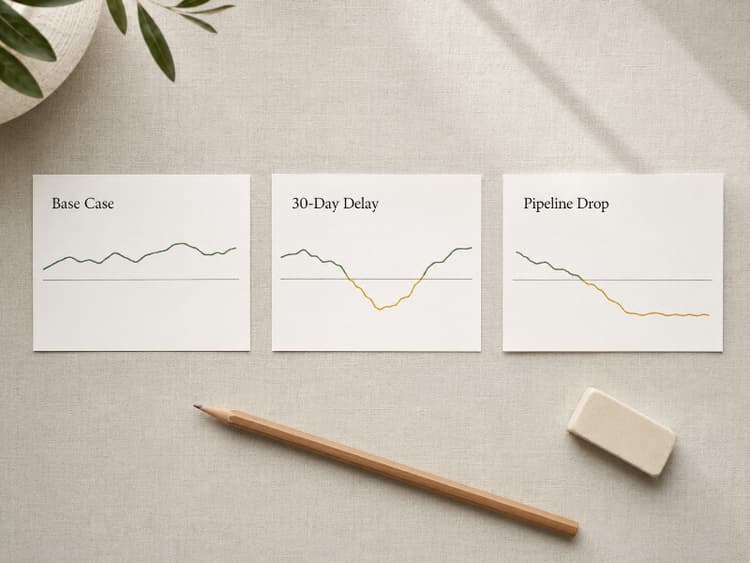
A basic forecast assumes everything goes according to plan. Run these three scenarios through your spreadsheet:
Scenario 1: A Net 30 client pays late. Pick your largest outstanding invoice and push it back two weeks. What happens to the weeks around your tax payment?
Scenario 2: A project ends without a replacement. Remove one client's pipeline entirely for the last month of your forecast. How quickly does your balance drop?
Scenario 3: A new project ramps slowly. You signed a contract, but onboarding delays push the first milestone payment back 3-4 weeks. Does your buffer hold?
If any scenario puts your balance near zero, you have 6-8 weeks to fix it instead of 6-8 days. A forecast doesn't prevent bad months. It keeps them from arriving as surprises.
Track every invoice from draft to paid.
BillerBear shows invoice statuses and outstanding balances, giving you cleaner inputs for your cash flow forecast.
Create a free invoice →What to Do When the Forecast Shows a Gap
Spotting a cash gap weeks out gives you options that disappear when you're already in the red.
Tighten payment terms on new work. If you're quoting Net 30, try Net 15. Shorter terms compress the gap between work and cash. For how to write terms that actually get paid on time, see How to Write Payment Terms That Prevent Delays. Another option: offer an early-payment discount like 2/10 Net 30 to incentivize faster payment on large invoices. See Early Payment Discounts for Freelancers for the cost-benefit math.
Require deposits on upcoming projects. A 30-50% upfront deposit on a $5,000 project puts $1,500-$2,500 in your account before delivery. It's the fastest way to shift cash earlier in a project's timeline. See Upfront Deposits: Why Freelancers Should Never Work for $0 Down.
Follow up on overdue invoices now, not later. An overdue invoice is often easier to recover at five days past due than at 45. Use the timing guidance in When to Follow Up on an Invoice and automate the first touches so you don't have to think about it.
Structure longer projects as milestone billing. Instead of one invoice at the end, break the project into 3-4 paid milestones. One large, uncertain inflow becomes several smaller, earlier ones.
Add a retainer or recurring client. Predictable monthly revenue stabilizes the bottom of your forecast. Even one retainer client at $2,000/month changes the shape of your cash flow.
Keep It Running: 30 Minutes a Month
A forecast is only useful if it's current. Here's the monthly maintenance routine:
- Update paid invoices. Mark everything that came in and adjust the dates of anything that arrived early or late.
- Add new invoices and pipeline. Any new work signed, scoped, or invoiced goes into the next 90 days.
- Adjust outflows. Add any new expenses or remove ones that ended.
- Roll the window forward. Drop the past month, extend 4-5 weeks into the future.
- Check the low points. Are there any weeks where the ending balance gets uncomfortable? If so, act now.
Over time, you'll build a clearer picture of each client's actual payment behavior versus their stated terms. That history makes every future forecast more accurate.
Your Invoices Already Have the Data
Every invoice you've sent has a date, an amount, and a payment status. Every client has a pattern you can track over time: early, on time, or late. Recurring invoices are scheduled future inflows. Milestones and retainers, if you use them, add more structure to the pipeline.
The missing piece is a forward-looking view. Ninety days. Twelve weeks. One spreadsheet.
Ready to create clearer invoices?
Create up to 3 invoices per month free. No credit card required.
BillerBear Editorial
Continue reading
How to Match Invoices to Bank Deposits: A Freelancer Reconciliation Workflow
Paid invoices and bank deposits should match, but fees, batched payouts, and partial payments break the math. Here's a monthly workflow to close the gap.
Accounts Receivable for Freelancers: How to Track Outstanding Invoices and Know When Cash Is Real
A weekly AR review using simple aging buckets tells you what clients owe, what's overdue, and what's at risk of never being paid. Here's how to build the habit.
Quarterly Estimated Taxes for Freelancers: Calculate Payments From Paid Invoices
Learn when quarterly estimated tax payments are due, how to calculate what you owe using your paid invoices, and how to avoid underpayment penalties and April surprises.