

You had a good freelance year. Your invoices were paid, your receipts were saved, and you filed on time. Then the bill landed: income tax, self-employment tax, and an underpayment penalty. Thousands more than you expected.
The penalty stings most. Not because it's the biggest line item, but because it was avoidable. The IRS expected you to pay as you earned, not in one April lump sum.
Quarterly estimated taxes are how freelancers stay current. If your invoices and payment records are organized, the calculation is straightforward. Here's how to do it.
This post is educational and does not constitute tax, legal, or accounting advice. Estimated tax rules vary by situation. Consult a tax professional for guidance on your specific circumstances.
Who Needs to Pay Quarterly
If you're a freelancer receiving 1099 income, nobody withholds taxes from your payments the way a W-2 employer would. Federal taxes are your responsibility to pay as you earn.
The IRS generally requires estimated tax payments when two conditions are both true: you expect to owe $1,000 or more in federal tax for the year (after subtracting withholding and credits), and you expect your withholding and credits to cover less than the smaller of 90% of your current-year tax or 100% of your prior-year tax. For most full-time freelancers with no W-2 withholding, both conditions are easy to meet.
Self-employment tax is 15.3% (12.4% Social Security, up to the annual wage base, plus 2.9% Medicare), applied to 92.35% of your net self-employment earnings. Stack federal income tax on top, and the combined rate for many freelancers falls somewhere between 25% and 35% of net income, depending on bracket, deductions, and filing status.
Wait until April and you're not just paying the full amount at once. You may also owe a penalty for not paying along the way, even if other parts of your return work out in your favor.
2026 Quarterly Due Dates
Estimated taxes are paid four times a year using Form 1040-ES. The standard due dates for 2026 tax year payments (per IRS Form 1040-ES):
- Q1 (Jan 1 – Mar 31): April 15, 2026
- Q2 (Apr 1 – May 31): June 15, 2026
- Q3 (Jun 1 – Aug 31): September 15, 2026
- Q4 (Sep 1 – Dec 31): January 15, 2027
If a due date falls on a weekend or federal holiday, the deadline shifts to the next business day. The IRS website confirms exact adjusted dates each year.
The periods aren't equal. Q2 covers two months of income; Q4 covers four. Keep that in mind when your Q2 payment looks small next to Q4.
You can skip the January 15 payment if you file your full 2026 return and pay the remaining balance by February 1, 2027.
The Invoice-Based Calculation
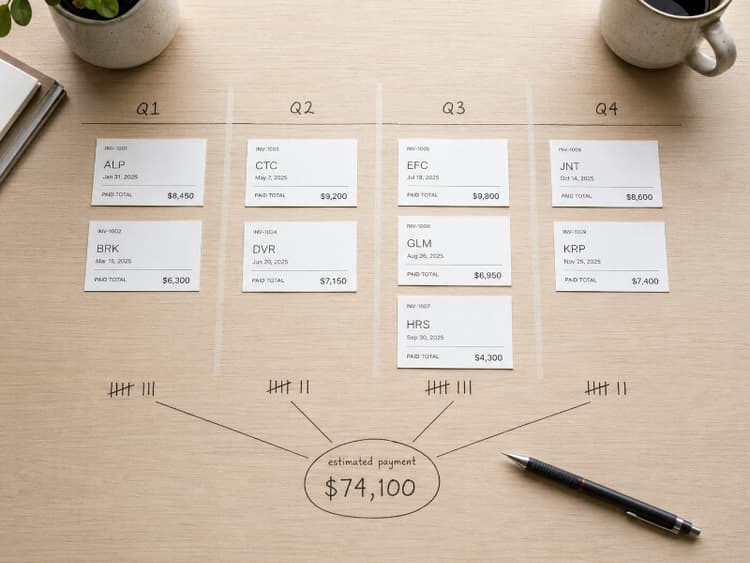
Many freelancers use cash-basis accounting: income counts when payment is received, not when the invoice is sent. Your paid invoices for the quarter are the starting point.
Step 1: Total your received payments for the quarter.
Pull up every invoice marked as paid during the period. Filter by payment date, not invoice date.
Step 2: Subtract non-income items.
Remove reimbursable expenses that passed through your invoices. These aren't taxable income. For how to separate them clearly, see How to Invoice Reimbursable Expenses.
Also exclude any sales tax you collected on invoices. That money belongs to the state, not to your income total. See Sales Tax for Freelancers for the full breakdown.
Step 3: Deduct business expenses.
Subtract your deductible business expenses for the quarter: software, home office, equipment, marketing, professional services. If you're not tracking these monthly, Freelancer Deductions You Should Already Be Tracking covers the major categories.
What remains is your approximate net self-employment income for the quarter.
Step 4: Estimate the tax.
Multiply your net income by your estimated combined tax rate. For many freelancers, 25–30% is a reasonable starting range covering both income tax and self-employment tax. Your actual rate depends on total annual income, filing status, deductions, and credits.
For a more precise number, the IRS provides the 1040-ES worksheet, which walks through the full calculation step by step. A CPA can also set your quarterly target based on your prior year's return.
Putting It Together: A Quick Example
Paid invoices this quarter: $18,000 Reimbursed client expenses: −$700 Business expenses: −$3,300 Estimated net income: $14,000 Set-aside at 30%: $4,200
Your quarterly payment target in this scenario would be roughly $4,200. The exact rate depends on your bracket and filing status, but the invoice-based starting point is the same: paid invoices, minus what isn't income, minus deductions.
This is easier when your invoicing tool records payment dates, not just invoice dates. That payment-date view is what turns estimated taxes from a guessing game into a quarterly review.
Safe Harbor: How to Avoid Underpayment Penalties
You don't need to nail the exact amount each quarter. The IRS provides safe harbor rules. Meet any of these and you won't owe an underpayment penalty, even if your final bill is higher than your payments:
Path 1: You owe less than $1,000 at filing after subtracting all payments and credits.
Path 2: Your quarterly payments (plus any withholding) total at least 90% of your current-year tax liability.
Path 3: Your quarterly payments total at least 100% of your prior-year total tax (as shown on last year's return), split across four installments. If your adjusted gross income exceeded $150,000 in the prior year ($75,000 if married filing separately), the threshold is 110% instead of 100%. Your prior-year return must cover a full 12-month period for this to apply.
For freelancers with stable income, Path 3 is the simplest. Take last year's total tax, divide by four, and pay that each quarter. If your income jumped significantly this year, Path 2 keeps you closer to what you'll actually owe.

When Income Is Lumpy
Freelance income rarely arrives in neat quarterly blocks. You might earn 40% of your annual revenue in Q3 and very little in Q1.
Two ways to handle uneven income:
Equal installments from an annual projection. Estimate your full-year income, calculate total expected tax, divide by four. Simple, but you might overpay in slow quarters and feel a cash-flow pinch during busy ones.
Annualized installment method. IRS Schedule AI (part of Form 2210) lets you calculate each quarter's required payment based on income actually earned through that period. More paperwork, but it aligns your payments with when you actually received the money and can reduce or eliminate penalties you'd otherwise owe for uneven payments.
If your income swings significantly quarter to quarter, the annualized method or a conversation with your CPA is worth the effort. If income is reasonably steady, equal installments work fine.
For predictable recurring revenue that makes quarterly forecasting easier, see Recurring Invoices: How to Set Up Automatic Billing.
If you want to go further and build a week-by-week view of when invoice payments will actually land versus when expenses are due, see Freelance Cash Flow Forecasting: A 90-Day Plan for Uneven Income.
How to Actually Pay
The IRS accepts quarterly estimated payments through several channels:
- IRS Direct Pay (irs.gov): free, directly from your bank account. You can schedule payments up to 365 days in advance.
- EFTPS (Electronic Federal Tax Payment System): free, but requires enrollment before your first payment.
- Credit or debit card: through IRS-approved processors. Convenience fees apply.
- Check or money order: mailed with a 1040-ES payment voucher.
IRS Direct Pay is the fastest option for most freelancers. Scheduling all four payments at the start of the year removes the risk of missing a deadline.
Many states with income tax also require their own quarterly estimated payments, often with different forms and due dates. Check your state's revenue department for specifics.
How Your Invoice Records Make This Easier
The hardest part of quarterly estimated taxes isn't the math. It's knowing what you actually earned.
When your invoices track paid vs. unpaid status and record payment dates, you already have the raw data. Each quarter, reviewing your paid invoices gives you gross income. Subtract expenses and you have net income. Apply your rate and you have the payment amount.
Without organized records, you're either guessing or procrastinating. Guessing is how April surprises happen.
For the broader workflow of keeping invoice records clean for tax time, see The Freelancer Tax Prep Checklist. Reconciling paid invoices against bank deposits before each quarterly calculation keeps the numbers accurate. See How to Match Invoices to Bank Deposits for that step. If clients send you a W-9 request or you receive a 1099-NEC that doesn't match your records, W-9 for Freelancers explains how to reconcile.
Pay Quarterly, File Once
Quarterly estimated taxes are an ongoing obligation, not a one-time event. Once the system is running, it takes about 30 minutes per quarter: review paid invoices, subtract expenses, calculate, pay.
The alternative is a single large bill in April, plus a penalty for not paying along the way.
Ready to create clearer invoices?
Create up to 3 invoices per month free. No credit card required.
BillerBear Editorial
Continue reading
How to Match Invoices to Bank Deposits: A Freelancer Reconciliation Workflow
Paid invoices and bank deposits should match, but fees, batched payouts, and partial payments break the math. Here's a monthly workflow to close the gap.
Accounts Receivable for Freelancers: How to Track Outstanding Invoices and Know When Cash Is Real
A weekly AR review using simple aging buckets tells you what clients owe, what's overdue, and what's at risk of never being paid. Here's how to build the habit.
Freelance Cash Flow Forecasting: A 90-Day Plan for Uneven Income
Build a simple 90-day cash flow forecast from your invoice pipeline so you can spot payment gaps early, plan around slow-paying clients, and stop reacting to uneven freelance income.