

You spent Tuesday debugging a client's API integration. Wednesday was three meetings and a round of revisions. Thursday you answered twelve Slack messages, rewrote a component, and squeezed in 40 minutes on a different client's project.
Friday, you sit down to invoice. How many hours did you actually work on each client? What counted as billable? You're guessing.
Many freelancers who bill hourly lose money not because their rate is wrong, but because they don't capture time while the work is happening. The invoice is only as good as the log behind it.
Why Reconstructing Hours at Month End Fails
Billing from memory is one of the most common time-tracking mistakes freelancers make. You finish a project, open your invoicing tool, and try to rebuild two or four weeks from calendar entries, commit histories, and gut feeling.
You undercount small tasks, forget meetings, round down out of guilt, and leave money on the table. Missing even 2–3 hours per week at $100/hr is $200–$300 you never invoice. Over 50 working weeks, that's $10,000–$15,000 in revenue that vanished because you didn't write it down.
Reconstructed invoices also produce vague line items. "Development work, 14 hrs" doesn't give the client enough to verify, and vague invoices invite disputes. For what happens when a client pushes back, see What to Do When a Client Disputes Your Invoice.
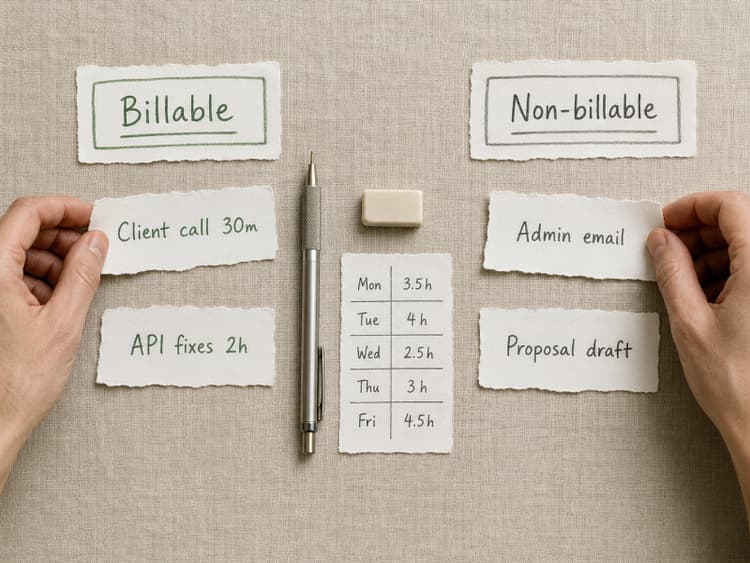
Billable vs. Non-Billable: What to Log, What to Skip
Before you track accurately, define what counts.
Billable time: work you can charge directly to a client. Design, development, writing, consulting, revision rounds, client calls, research tied to a deliverable.
Non-billable time: everything else. Prospecting, bookkeeping, learning a tool for your own benefit, admin, marketing your business.
The gray area trips people up:
- Client emails and Slack messages: billable when they're part of active project work (clarifying requirements, feedback, reviewing deliverables). Not billable when they're pre-sales or relationship maintenance.
- Revision rounds: billable up to whatever your contract specifies. If the agreement includes two rounds, the third is either scope expansion or a goodwill call. Define this in the contract so it's never a surprise. See Freelance Contracts That Actually Protect Payment.
- Research and learning: often billable when the client's project requires it (learning their stack, reading their brand guidelines). Not billable when it's general skill development. Your contract should spell out whether project-specific research counts.
- Meetings: often billable when the client requests or schedules them, but check your agreement. A 45-minute call is 45 minutes you can't spend on other paid work. Some contracts exclude brief status syncs or cap meeting time separately.
Log non-billable time too. Not to invoice, but to see your effective hourly rate. If you bill 25 hours at $120/hr but spend 15 hours on unbilled admin, your true rate is closer to $75/hr. For more on this math, see How to Set Freelance Rates for the First Time.
A Minimum Viable Time Log
You don't need an elaborate system. Capture five fields consistently:
- Date
- Client
- Task or deliverable (specific enough to become an invoice line item)
- Duration (to the nearest increment you bill, typically 15 minutes)
- Notes (optional but valuable for scope disputes)
A spreadsheet, a timer app, or a plain text file all work. What fails is logging tomorrow what you did today.
Here's what two days of entries look like in practice:
Jun 9
- Acme Co — Dashboard responsive fixes — 1.5 hrs ✓
- Acme Co — Project status call — 0.5 hrs ✓
- Internal — Update portfolio site — 0.75 hrs (non-billable)
Jun 10
- Nova Labs — API endpoint development — 2.25 hrs ✓
- Acme Co — Slack feedback + revisions — 0.5 hrs ✓
- Internal — Quarterly tax prep — 0.5 hrs (non-billable)
Nothing fancy. Every entry has a client, a task, and a duration captured the same day. The ✓ marks billable time; everything else gets logged but doesn't go on an invoice.
Minimum billable increments: Many freelancers bill in 15-minute blocks. Some use 6-minute increments, especially in legal billing and consulting. Whatever you choose, stay consistent and tell your client upfront. A 12-minute call may be billed as 0.25 hours if 15-minute increments were agreed on. A 3-minute email billed as 0.25 hours will raise eyebrows if the client isn't expecting that rounding.
When to log: at the end of each task, not at the end of the day. By 5 PM, a 90-minute morning task feels like "about an hour." By Friday, Monday is a blur.
Tracking Across Multiple Clients
With two or more hourly clients, context-switching without logging is where hours disappear.
Keep entries separated by client from the start. Don't batch "freelance work: 6 hours" and split it later. When you switch from Client A's project to Client B's bug fix, close one entry and start another.
For retainer clients with monthly hour caps, tracking matters even more. You need to know you're at 18 of 20 contracted hours before a "quick request" pushes you to 23. For structuring those arrangements, see Freelance Retainer Agreements.
The Weekly Review: 20 Minutes That Protect Your Invoice
Don't wait until invoice day to reconcile your logs. A short weekly review catches gaps while the work is still fresh.
Every Friday (or whatever day works), spend 20 minutes on this:
- Scan for gaps. Did you work Tuesday afternoon but have no entries between 1 and 4 PM? Fill them in now.
- Rewrite vague descriptions. Will future-you understand what "API stuff" means in three weeks?
- Flag scope creep. Did you do work outside the original agreement? Note it now so you can invoice or discuss it before it becomes a pattern. See Scope Creep: How to Bill for "Just One Small Change".
- Compare hours to retainer caps. Approaching a client's monthly limit? Send a heads-up before you go over.
Twenty minutes on Friday beats reconstructing the month from memory.
Turn your time log into an invoice.
BillerBear lets you add hourly line items (hours × rate) with automatic totals, then send a clean PDF.
Create a free invoice →Turning Logs Into Invoice Line Items
Good tracking makes invoicing fast. Group entries into line items a client can read and approve.
Once your log is clean, the next question is how often to invoice those hours. For guidance on weekly vs. biweekly vs. monthly cadence, see When to Send an Invoice as a Freelancer.
Group by task or deliverable, not by day. A client doesn't need Monday 1.5 hrs, Wednesday 2 hrs, Friday 45 min. They need:
Frontend development (Jun 9–13): Dashboard redesign and responsive fixes — 4.25 hrs @ $110/hr — $467.50
Batch small entries. Five 15-minute Slack threads become one line:
Client communication and feedback (Jun 9–13) — 1.25 hrs @ $110/hr
Separate line items for every micro-task make the invoice unreadable.
Keep detail in your log, not always on the invoice. If the client asks what the 4.25 hours of frontend work covered, your log should have dates, tasks, and notes ready.
For line-item formatting, see Hourly vs. Flat Rate Invoicing: How to Bill Clients Clearly. For the full anatomy of a professional invoice, see How to Create a Professional Invoice.
Common Time-Tracking Mistakes
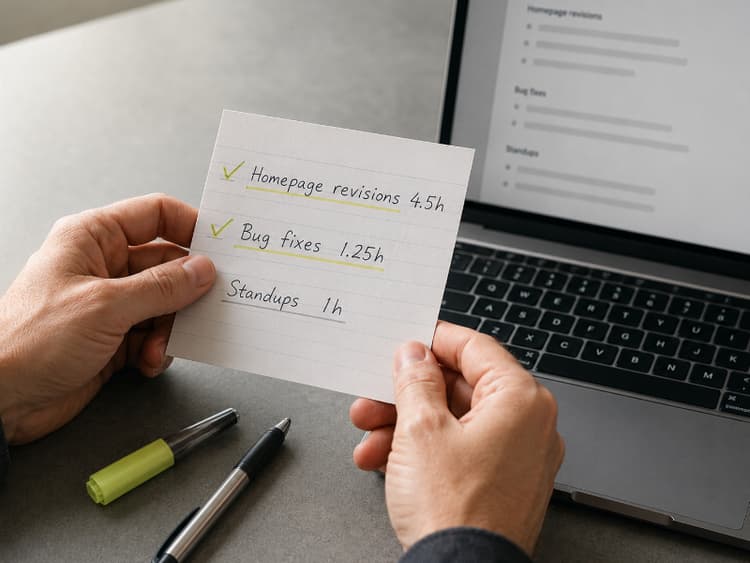
Logging in batches. By Friday, half of Monday is gone. Log when you finish a task or work block.
Rounding everything to neat hours. If every entry is exactly 1.0 hours, clients notice. Round to your stated increment and note entries where rounding matters.
Mixing personal and client time. If you spent 2 hours learning a framework one client's project uses, bill only the portion tied to their deliverable. Write a note explaining why.
Skipping meetings. If your agreement treats client-requested meetings as billable, a 30-minute call is 30 minutes that belong on the invoice. Meeting time is one of the fastest ways freelancers underbill.
Never reviewing the log. A log you don't reconcile fills with gaps and vague labels. Review weekly.
What a Good Log Gets You
An accurate log means you bill for work you actually did. A detailed log means every line item traces to a dated entry if a client questions it. Both beat rebuilding the month from memory when invoice day arrives.
Frequently Asked Questions
Are client emails billable? It depends on your contract and the nature of the email. Messages tied to active project work (clarifying requirements, reviewing deliverables, coordinating revisions) are typically billable. Pre-sales conversations, general relationship check-ins, and internal admin are not. When in doubt, define what counts in your agreement before work starts.
Should freelancers bill for meetings? If the meeting was requested by the client and is part of the project engagement, many freelancers treat it as billable time. The key is that your contract or rate agreement should specify whether meetings are included. A 45-minute strategy call is time you can't spend on other paid work, so it's reasonable to bill for it if the arrangement supports that.
What is the best billing increment for freelancers? There's no universal answer, but 15-minute increments are widely used among freelancers. Some professionals, especially in legal and consulting, bill in 6-minute (0.1 hour) blocks. Choose the increment that fits your work style and make sure the client agrees to it upfront. Consistency matters more than granularity.
Ready to create clearer invoices?
Create up to 3 invoices per month free. No credit card required.
BillerBear Editorial
Continue reading
Productized Services for Freelancers: How to Price Packages and Invoice Them Clearly
Turn repeat freelance work into fixed packages with clear scope, tiered pricing, and invoices that match what clients bought.
Hourly vs. Flat Rate Invoicing: How to Bill Clients Clearly
Compare hourly and flat-rate freelance billing, then learn how to itemize each model on your invoice with line-item examples and mistakes to avoid.
Freelance Contract Renewal Pricing: How to Raise Rates Without Losing the Client
Renewal conversations are where freelancers quietly grow income or accept a stale rate. Here's how to reprice retained clients at renewal without burning the relationship.