
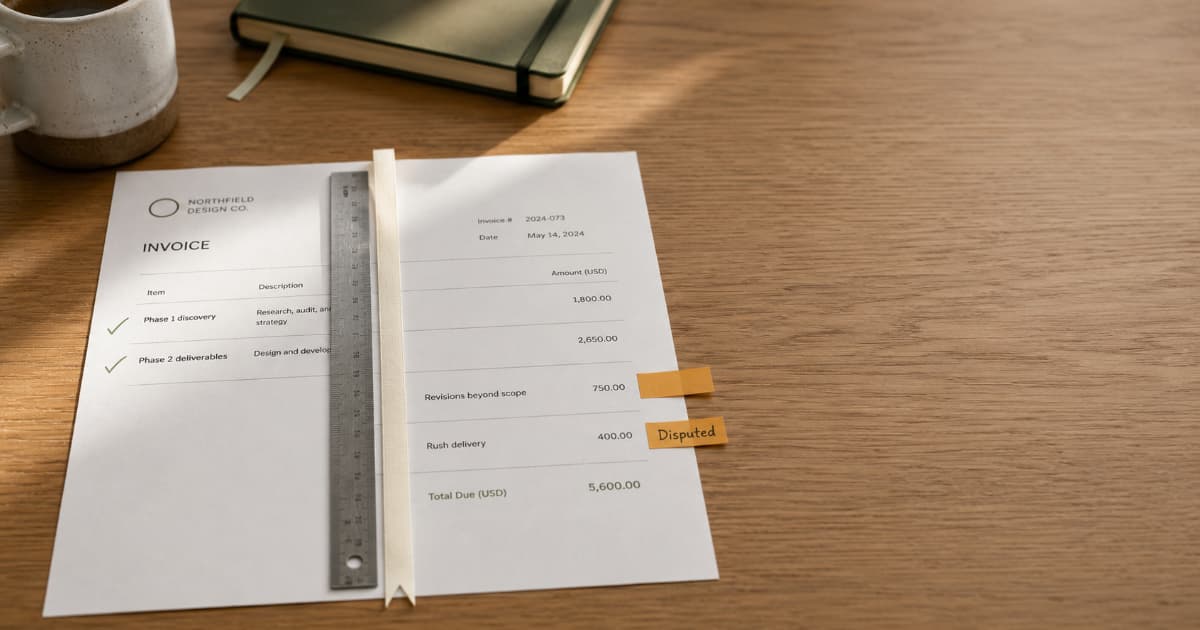
Your client didn't ghost you. They didn't refuse to pay. They replied and told you the invoice is wrong.
Maybe they think a line item wasn't agreed on. Maybe they're unhappy with the quality. Maybe they saw a number they weren't expecting and want answers. That's an invoice dispute. It needs a different playbook than chasing a silent client or fighting a bank reversal.
Here's how to classify the dispute, respond without giving away money you earned, and resolve it before the disagreement turns into a formal collection or legal issue.
The Short Version: Your 5-Step Invoice Dispute Playbook
- Identify what they're disputing. Scope, quality, an unauthorized charge, a math error, or a milestone disagreement. The response is different for each.
- Pull the agreement, approvals, and delivery proof. Your contract, quote, written sign-offs, and delivery records are your leverage.
- Respond calmly with specific references. Map each disputed line item to the document that supports it.
- Ask for payment on the undisputed amount. Don't let one contested line item freeze the entire invoice.
- Revise, negotiate, or escalate based on the evidence. If you're wrong, correct it fast. If the contract backs you, hold the line.
The rest of this article walks through each step in detail.
First: Classify the Dispute
Not all pushback is the same. Your response depends on what the client is actually contesting.
Scope mismatch: They agreed to X deliverables, but you invoiced for Y. Or they believe the scope was narrower than what you billed. This is one of the most common disputes in project-based work.
Quality complaint: They received everything listed but say the work doesn't meet expectations. They may want revisions before paying, or a discount.
Unauthorized line item: A charge they didn't expect: a rush fee, an add-on you considered part of the scope, or reimbursable expenses they weren't told about in advance.
Math or admin error: Wrong total, wrong tax rate, duplicated line, or invoiced to the wrong entity. This one is on you, and it's usually the quickest to resolve.
Milestone or deliverable disagreement: They say a milestone wasn't complete, so they're withholding that portion. Common in phased projects with subjective acceptance criteria.
The fix depends on the type. If you made a genuine error, correct it and move on. If it's a disagreement about value or scope, you need evidence, not just a follow-up email.
If the client has no complaint about the work and simply wants a lower price, that's a discount request rather than a dispute. Client Asks for a Discount? How to Respond at Every Stage covers what to say.
Gather Your Evidence Before Responding
Resist the urge to reply immediately. Before you write anything, pull together the paper trail:
- The original quote, proposal, or scope document. If you sent a formal quote before starting, it anchors what was agreed. See Freelance Quote vs Invoice: When to Send Each for why this distinction matters.
- Contract or agreement. Clauses on scope, deliverables, and acceptance terms are often your strongest evidence. The tighter the contract, the less room for interpretation. See Freelance Contracts That Actually Protect Payment: 5 Clauses You Need.
- Written approvals. Emails, Slack messages, or tool notifications where they signed off on deliverables, milestones, or direction changes.
- Revision history or delivery records. File transfer receipts, access logs, deploy records. Anything that proves work was delivered.
- The invoice itself. Clear, itemized line items that match the contract make your position harder to argue with. Vague descriptions ("consulting services: $4,000") invite disputes.
Strong invoicing habits matter before there's a problem. If your invoice references a specific SOW or quote number, ties each line item to agreed deliverables, and includes payment terms the client already accepted, you're in a much stronger position when something gets contested.
Respond: Factual, Specific, Not Defensive
Once you have the documents, respond with substance.
Keep the tone calm and factual. Reference specific documents. Don't editorialize about the relationship or how you feel. This structure works for most dispute types:
Hi [Client],
Thanks for flagging this. I want to make sure we're aligned.
Invoice #[X] covers [brief scope description], as outlined in [quote/contract/email from DATE]. Here's how the line items map:
- [Line item] → [reference to agreement or approval]
- [Line item] → [reference to deliverable sign-off]
I've attached [contract/quote/approval email] for reference. Let me know if there's a specific item you'd like to walk through.
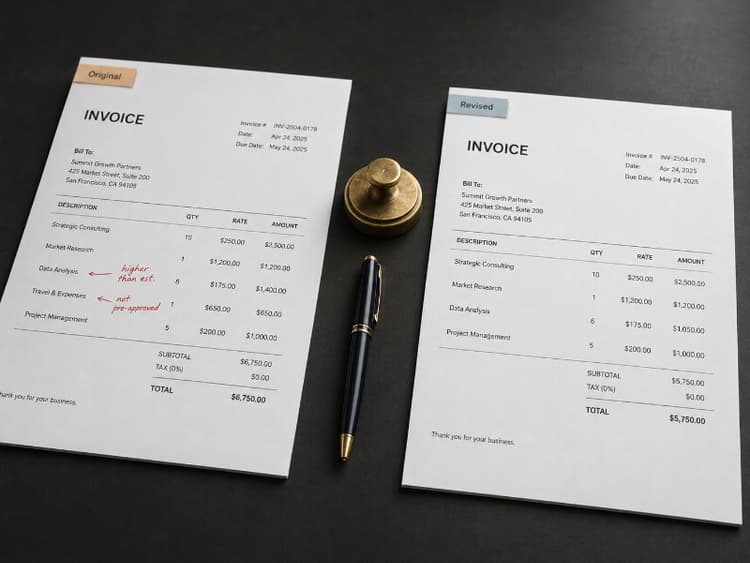
If the dispute has merit (you made a mistake, or something genuinely wasn't agreed), acknowledge it directly. Issue a corrected invoice or credit note. For mechanics on how to handle that cleanly, see How to Correct an Invoice After Sending It.

Build a cleaner invoice trail from the start.
BillerBear keeps itemized line items, sequential invoice numbers, and PDF exports that back you up in disputes.
Create a free invoice →Separate the Disputed Portion From What's Clear
One practical move in any invoice dispute: don't let the contested line item hold up the rest.
If the client agrees with $4,200 out of $5,000 but disputes an $800 add-on, request payment on the undisputed amount while you work through the contested item. This keeps cash flowing and signals that you're reasonable.
Here's a template for requesting payment on the undisputed portion:
Hi [Client],
Thanks for clarifying the concern. Based on your note, it sounds like the disputed portion is [specific line item/amount]. The remaining [amount] covers the agreed and delivered work listed in [quote/contract/SOW].
To keep things moving, please pay the undisputed balance of [amount] by [date]. I'm happy to review the disputed item separately and walk through the documentation together.
Best, [Your Name]
For how to structure split payments on a single project, see Partial Payments on Invoices: How to Track Deposits, Balances, and Split Payments.
When to Revise vs. When to Hold the Line
Not every dispute calls for a concession. Not every hill is worth dying on either.
Revise when:
- You made a genuine error (math, tax, wrong description)
- The scope was ambiguous and you didn't clarify before billing
- The add-on was real but you never communicated it before invoicing
- Revising preserves a valuable long-term relationship and the amount is small
Hold the line when:
- The contract or quote clearly covers the charge
- You have written sign-off on the deliverable
- The client approved changes that expanded scope, and you billed accordingly
- The "quality" complaint is buyer's remorse, not a documented deficiency
Depending on the dispute type and your evidence, resolution typically lands on one of these outcomes:
- Corrected invoice (you made an error and fix it)
- Partial credit (you agree part of the charge was wrong)
- Revised due date (scope took longer and terms shift)
- Payment plan (large balance split into installments; see How to Set Up an Invoice Payment Plan for the full setup)
- Split invoice (undisputed paid now, disputed resolved separately)
- Written settlement (both sides agree to a reduced amount in writing)
- Formal escalation (demand letter, collections, or legal)
If you were billing hourly, your time logs become key evidence. A dated, task-level log is much harder to dispute than a vague hour total reconstructed from memory. For how to build that habit, see How to Track Billable Hours as a Freelancer. If flat rate, the deliverable spec matters more than hours spent. For context on how these models affect invoicing, see Hourly vs. Flat Rate Invoicing: How to Bill Clients Clearly.
If Negotiation Doesn't Resolve It
Some disputes don't end with a polite email exchange. If you've shared evidence, offered reasonable solutions, and the client still refuses to pay what's owed, you're moving from dispute resolution to collections.
At that point, the playbook shifts:
- Formal demand letter: A structured, factual letter that puts them on notice. See How to Write a Demand Letter for an Unpaid Invoice.
- Escalation plan: When polite emails have failed, a stepped approach protects you without burning bridges prematurely. See Client Won't Pay? A Freelancer's Escalation Plan.
- Write-off consideration: If the amount is small and evidence is thin, it may not be worth the hours. See When (and How) to Write Off an Unpaid Invoice.
A client disputing an invoice is not the same as a chargeback. A chargeback is a bank or processor pulling money after payment clears. That has its own deadlines and evidence rules. If that's your situation, see Client Chargeback? A Freelancer's Guide to Payment Reversals.
This article is general educational guidance for freelancers and small businesses. It is not legal, tax, or accounting advice. For high-value disputes or formal collections, consult a qualified professional in your jurisdiction.
Prevent the Next Dispute Before It Starts
Many invoice disputes trace back to something that happened before the invoice was sent: vague scope, verbal agreements, or surprise charges.
Stack the odds:
- Lock scope in writing before you start. A signed quote or contract with specific deliverables is your first line of defense. A freelance statement of work is where those deliverables, exclusions, and payment triggers get defined.
- Get milestone sign-off. If you bill by phase, get written confirmation that each phase is complete before invoicing it. See Milestone Billing for Freelancers.
- Communicate cost changes immediately. If scope expands, send a written change order before you bill. See Freelance Change Order Template for the document, approval workflow, and invoicing options. For smaller ad-hoc requests, see Scope Creep: How to Bill for "Just One Small Change".
- Use clear, itemized invoices. Line items that map to agreed deliverables leave less room for "I didn't agree to this."
- Cover the basics in onboarding. Payment terms, deliverable definitions, and approval processes should be settled before work begins. See Freelance Client Onboarding Checklist.
Disputes Are Normal. Your Response Is What Matters.
An invoice dispute isn't a personal attack. Sometimes it's a misunderstanding. Sometimes it's a real error. Sometimes the client is testing whether you'll cave.
Freelancers who handle this well tend to have one thing in common: documentation. A clear contract, itemized invoices, and a written trail turn "he said, she said" into "here's the agreement, here's the sign-off, here's the invoice."
Ready to create clearer invoices?
Create up to 3 invoices per month free. No credit card required.
BillerBear Editorial
Continue reading
Client Says They Paid Your Invoice but You Haven't Received It: What to Do Next
When a client insists they've paid but your bank shows nothing, don't argue and don't mark it paid. Here's a verification-first workflow to diagnose the gap and resolve it.
How to Set Up an Invoice Payment Plan That Protects Your Cash Flow
When a client can't pay the full invoice at once, a structured payment plan can recover the revenue. Here's how to decide when a plan makes sense, what to put in writing, and how to invoice each installment.
Net 60 Payment Terms? How to Negotiate Faster Payment as a Freelancer
When a corporate client sends a vendor agreement with Net 45 or Net 60, you don't have to accept it as-is. Counter-offers, scripts, and what AP teams sometimes accept.