

Someone told you to form an LLC. Maybe it was another freelancer, your accountant, or a client's AP team. The pitch is always the same: "You need an LLC. It protects you."
The LLC vs sole proprietor decision for freelancers comes down to what changes day to day, whether it saves you money on taxes (by default, it usually doesn't), and when the fees and paperwork are worth it.
If you freelance in the U.S. and haven't filed formation documents, you're already a sole proprietor. The question is whether switching to an LLC would change anything material for your work, your income, and your risk.
This article covers U.S. freelancers operating solo. It is for general information only and is not tax or legal advice. LLC rules, fees, and liability protections vary by state. Consult a qualified professional before making entity decisions.
LLC vs Sole Proprietor for Freelancers: Quick Comparison
Here's the quick comparison before we get into the details:
| Sole Proprietor | Single-Member LLC | |
|---|---|---|
| Setup | No state formation filing required (licenses, permits, or DBA registration may still apply) | State formation filing + fees |
| Ongoing costs | None (entity-specific) | Annual reports, state fees, possible minimum tax |
| Federal taxes (default) | Schedule C + SE tax | Same (disregarded entity) |
| Liability | Personal assets at risk | Generally limited to business assets (exceptions apply) |
| Invoicing | Personal name or DBA | LLC legal name |
| W-9 classification | Individual/sole proprietor | Depends on election (disregarded, S-corp, etc.) |
| Can get an EIN? | Yes | Yes |
| Can open business bank account? | Yes | Yes |
What You Already Are: Sole Proprietor
If you do freelance work in the U.S. and haven't filed formation documents with your state, you're generally operating as a sole proprietor. No state formation filing is required to operate as one, though licenses, permits, or DBA registration may still apply depending on your state and local rules. You report business income and expenses on Schedule C of your personal tax return. Self-employment tax generally applies when net earnings from self-employment are $400 or more. The general rate is 15.3%, covering Social Security (up to the annual wage base) and Medicare. Higher earners may also owe the Additional Medicare Tax. See the IRS self-employment tax guidance for calculation rules.
As a sole proprietor, you can:
- Get an EIN from the IRS (free; takes minutes online for those who qualify for the online application)
- Open a business bank account
- Register a DBA (doing business as) name
- Invoice clients under your name or DBA
- Deduct business expenses
None of that requires an LLC. Many freelancers assume they need one to look professional or operate legally. You don't. For what a separate account actually buys you, see 👉 Business Bank Account for Freelancers.
What a sole proprietorship does lack is legal separation between you and the business. Your business debts are your personal debts. If a client sued over your work, your personal assets could be at risk. Whether that matters depends on what you do and what's at stake.
What an LLC Actually Changes
A limited liability company is a legal entity separate from you. That separation is what you're paying for.
Liability protection (with caveats)
An LLC generally limits your personal liability for business debts and obligations. If the business is sued or can't pay a debt, your personal assets (home, savings, personal accounts) are typically shielded.
The protection isn't absolute. Courts can "pierce the corporate veil" if you didn't run the LLC as its own business. State rules differ, but red flags often include mixing personal and business funds, skipping required records, and treating the LLC like a personal checking account. Commingling alone is usually not enough; courts typically apply state-specific tests that look at multiple factors together.
Liability protection also usually won't cover your own negligence or professional malpractice. If you personally made the mistake that caused harm, the LLC may not help. The same applies if you signed a personal guarantee on a lease, loan, or client contract: that obligation is yours regardless of the LLC. Some lines of work need professional liability insurance regardless of entity type.
Federal taxes: usually the same (by default)
Most freelancers misunderstand this part. A single-member LLC is treated as a "disregarded entity" by default for federal income tax purposes, as explained in the IRS single-member LLC guidance. That means:
- You still file Schedule C on your personal return
- You still pay self-employment tax at the same rate
- Federal income tax treatment is usually the same as a sole proprietorship
- The IRS treats you the same as a sole proprietor
Forming an LLC alone does not reduce your federal taxes. Treatment changes only if you elect a different classification (S-corp or C-corp) with the IRS.

S-corp election: where the tax math can shift
An eligible LLC can elect to be taxed as an S-corporation by filing Form 2553 with the IRS. Under S-corp taxation, you pay yourself reasonable compensation subject to payroll taxes. After paying that compensation, the business may make distributions that are generally not subject to employment taxes. The IRS reasonable compensation rules require compensation to reflect the work you do. Note that the owner's share of S-corp profits is still reported as income for income tax purposes, even if the money stays in the business.
That can lower your self-employment tax bill, but only when net income is high enough that payroll tax savings beat the added cost of running payroll, filing an additional business return (Form 1120-S), and meeting S-corp compliance requirements. The breakeven point depends on your income, expenses, and state rules. There's no universal dollar figure. A CPA who knows your numbers should run the math before you elect.
State-level costs and compliance
LLCs carry ongoing costs sole proprietorships don't:
- Formation filing fees: Vary by state. Some charge under $100; others charge several hundred.
- Annual or biennial fees: Many states require annual reports or renewal fees. Some impose minimum taxes regardless of income. California, for example, charges an $800 annual LLC tax on most LLCs registered or doing business in the state.
- Registered agent: Nearly all states require one (requirements vary; Pennsylvania, for example, uses a registered office instead). That can be you (if you have an in-state address) or a paid service.
Those fees add up. A freelancer earning modest income may find annual maintenance costs exceed any practical benefit from the structure.
When Forming an LLC Makes Sense
There's no universal income threshold that triggers the need for an LLC. Certain situations make the case stronger:
- You're signing larger contracts. Bigger projects mean bigger financial exposure if something goes wrong. Liability protection gets more relevant.
- A client or vendor requires it. Some clients or vendor portals require or prefer a registered business entity. If you're losing work because you can't check that box, the filing cost is easy to justify.
- You have personal assets worth protecting. If you own a home or hold significant savings, liability separation matters more than it does when you have little to lose.
- You're hiring and want to limit exposure. A sole proprietor can hire employees and subcontractors, but an LLC adds a layer of liability separation between worker-related claims and your personal assets.
- You're ready to elect S-corp taxation. If your CPA has recommended S-corp election based on your income, you'll need an LLC (or corporation) as the underlying entity.
- You want to start building business credit. An LLC with its own EIN may help you begin establishing business credit over time, though lenders often still review personal credit for small or new LLCs.
When Staying a Sole Proprietor Is Fine
Not every freelancer needs an LLC. Forming one too early often means paying state fees for protection you don't yet need.
Staying a sole proprietor often makes sense when:
- You're testing freelancing part-time or just getting started
- Your contracts are small and your liability exposure is low
- You don't have significant personal assets at risk
- Your state has high LLC maintenance costs relative to your income
- You already carry professional liability or errors-and-omissions insurance that covers your work
A sole proprietorship doesn't stop you from invoicing professionally, opening a business bank account, or running a credible freelance business. Base the LLC decision on risk, income, and operational needs, not on pressure to look more "official."
Your invoicing works either way.
BillerBear saves your business name and details in your profile. Whether you invoice as a sole proprietor or an LLC, every invoice starts with the correct header.
Create a free invoice →What Changes Operationally When You Form an LLC
If you form an LLC, several pieces of your freelance workflow need updating:
Invoice header: Identify the LLC as the entity providing services. Use the LLC's full legal name, including "LLC." If AP has ever paused an invoice over mismatched names, you already know why this matters. See What Business Name Goes on a Freelance Invoice? for how the header should line up with your W-9 and payment details.
W-9: Send clients an updated W-9. For a disregarded single-member LLC, the owner's name goes on Line 1, the LLC name on Line 2, and the tax classification box reflects the owner's classification (typically individual/sole proprietor). The TIN is generally the owner's SSN or EIN, not the LLC's EIN. Walk through the fields in W-9 for Freelancers.
Bank account: If business and personal money still share one account, formation is a good forcing function. A business account in the LLC's name helps preserve the liability separation you paid for. 👉 Business Bank Account for Freelancers
Contracts: Sign new contracts on behalf of the LLC, using its legal name and identifying your role (e.g., "Alex Rivera, Member, Rivera Design LLC"). Existing client relationships may need updated agreements that name the new entity.
Tax prep: Federal filing doesn't change for a disregarded single-member LLC (still Schedule C), but you'll have state LLC compliance obligations: annual reports, fees, and possibly state tax filings. Add those deadlines to your freelancer tax prep checklist.
Here's what this looks like in practice: your invoice says "Rivera Design LLC" in the From block. Your W-9 shows "Alex Rivera" on Line 1 and "Rivera Design LLC" on Line 2, with individual/sole proprietor checked as the tax classification. The client updates their vendor record to connect both names before the next payment. The names appear in different fields, but the documentation is correct and consistent.
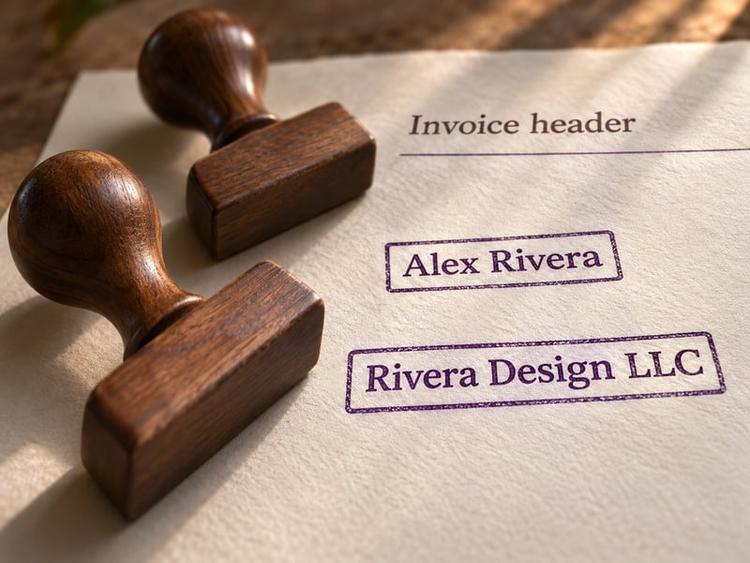
These updates aren't difficult. Skip them and you get mismatches between your invoice, W-9, bank account, and contracts. Those mismatches cause payment delays and vendor-setup headaches, the kind invoicing corporate clients warns about.
File When the Stakes Justify It
Entity structure is a risk and paperwork decision, not a badge of legitimacy. Plenty of freelancers run for years as sole proprietors and never file. Others need an LLC before their second corporate client will onboard them.
If you're early in your career, get the basics right first: a clean invoice header, separated finances, and records that survive a Schedule C review. How to Send Your First Invoice as a Freelancer covers the invoicing side. For quarterly payments, see Quarterly Estimated Taxes for Freelancers.
When contract size, client requirements, personal assets, or S-corp math push liability protection or entity credibility to the foreground, that's when filing tends to pay off.
BillerBear works the same whether you're a sole proprietor or an LLC. Create professional invoices, track what clients owe, and mark payments as they clear, so your records stay aligned no matter how your business is structured. Create a free account.
Ready to create clearer invoices?
Create up to 3 invoices per month free. No credit card required.
BillerBear Editorial
Continue reading
How to Send Your First Invoice as a Freelancer (Step-by-Step)
You finished the work. Now you need to get paid. Here's the exact sequence for sending your first freelance invoice without second-guessing every detail.
Business Bank Account for Freelancers: Do You Need One?
Mixing client payments with personal spending makes reconciliation harder, tax prep slower, and audit trails messier. Here's when freelancers need a business bank account and how to set one up.
Invoice vs. Receipt vs. Purchase Order: What's the Difference?
Clients ask for receipts when they need invoices, and companies send POs expecting you to know what to do. Here's a simple breakdown of each document and when to use it.