

A client pays your invoice. The deposit lands in the same account you use for groceries, rent, and streaming subscriptions. Three months later, you're scrolling through transactions trying to figure out which $1,200 deposit was the freelance project and which was a Venmo transfer from your roommate.
That mix is common. It is also avoidable. Opening a separate business bank account for freelancers is one of the simplest financial moves you can make, and you do not need an LLC, a CPA, or a business plan to do it.
You do need to know when separation matters, what breaks when you skip it, and how to connect the account to your invoicing workflow so it actually helps.
This article covers U.S. freelancers. It is for general information only and is not tax or legal advice. Bank requirements, DBA rules, and entity-naming laws vary by state. Confirm your specific situation with a qualified professional.
Do Freelancers Need a Business Bank Account?
It depends on your business structure.
Sole proprietors generally aren't required by federal tax law to maintain a separate business bank account. State and bank requirements can differ. The IRS recommends keeping business and personal finances separate, but it does not mandate a specific business checking account for sole proprietors. You report that income on Schedule C regardless of which account the money sits in.
"Legally allowed" and "practically smart" are not the same thing.
LLCs have a stronger case for separation. If you formed an LLC for liability protection, commingling personal and business funds can be one factor courts consider when deciding whether the LLC has genuinely been operated as a separate entity. That analysis, often called "piercing the corporate veil," depends on state law and multiple factors beyond commingling alone. A dedicated business account is one of the clearest ways to keep that boundary intact.
Most freelancers billing more than a few hundred dollars a month benefit from a dedicated account. Here is why:
- Tax prep gets faster. When business deposits are client income and business withdrawals are expenses, categorizing is straightforward. You are not scrolling through personal purchases trying to flag what might be deductible.
- Reconciliation actually works. Matching invoices to deposits requires identifiable business deposits. Mix client payments with personal transfers and reconciliation turns into guesswork. See How to Match Invoices to Bank Deposits for the full workflow.
- Recordkeeping is cleaner. If the IRS questions a deduction or a reported income figure, a dedicated business account makes it easier to support your records. A personal account full of mixed transactions makes that harder. Bank statements alone do not substantiate every deduction; you still need invoices and receipts.
- Clients get fewer payment headaches. Payment instructions on your invoice should point to a business account with a payee name that aligns with your invoice header and W-9. A wire to "John Smith Personal Checking" when the invoice says "Smith Design LLC" creates confusion and AP delays.
What "Separating Your Finances" Actually Means
Separation does not require a complex bookkeeping system. At its simplest:
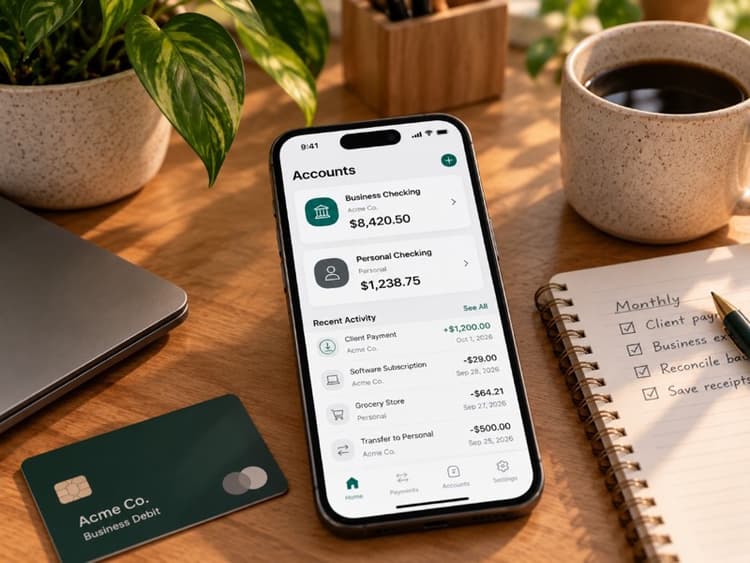
- All client income goes into one dedicated account. Every invoice payment, whether it arrives by ACH, wire, PayPal, Stripe, or check, gets deposited or routed to your business checking account.
- All business expenses come out of that same account (or a linked business card). Software subscriptions, equipment, subcontractor payments, business travel: if it is deductible, pay it from the business account.
- Personal spending stays out. No grocery runs on the business debit card. No rent from the business account. Transfers to your personal account should be intentional owner draws, not accidental mixing.
Three rules. That is the whole system at the start.
The point is not perfection on day one. It is a boundary that makes monthly reconciliation, quarterly estimated taxes, and annual tax prep easier.

How to Open a Business Bank Account as a Freelancer
Opening a business checking account is simpler than most freelancers expect.
What You'll Need
Requirements vary by bank, but most institutions ask for:
- Government-issued ID (driver's license or passport)
- Social Security Number (SSN) or EIN. Sole proprietors can use their SSN. Banks may ask an LLC for an EIN, although a single-member LLC without employees or certain excise-tax obligations may not need one for federal income-tax purposes. Some banks accept the owner's SSN instead.
- Business formation documents (if applicable). LLCs typically need their formation documents (often called Articles of Organization or Certificate of Formation, depending on the state). Sole proprietors using a DBA ("doing business as") name may need the DBA registration certificate from their state or county, depending on local rules and bank policy.
- An initial deposit. Some banks require an opening deposit; others don't. Minimums vary by institution.
Choosing the Right Account
You do not need a premium business account built for a company with 50 employees. Look for:
- Low or no monthly fees. Many online banks and credit unions offer free or low-fee business checking, often with balance or transaction conditions.
- Enough free transactions. Check the monthly limit. Most freelancers do not process hundreds of transactions, but verify the cap before signing up.
- Easy integration. If you use invoicing software, check whether the bank supports the payment processors you list on invoices (PayPal, Stripe, Wise, direct bank transfer).
Skip the sign-up bonus hunt. Pick a bank that is simple, low-cost, and easy to check when you need to verify deposits against invoices.
Sole Proprietor vs. LLC: What Changes?
| Sole Proprietor | LLC | |
|---|---|---|
| Required? | Generally not required by federal tax law; state and bank rules may differ | Strongly recommended to maintain liability protection |
| Account type | Can open business checking with SSN and DBA | Requirements vary; banks may request an EIN or, for some single-member LLCs, the owner's SSN, plus formation documents |
| Payee name | Personal name or DBA | LLC legal name |
| Tax reporting | Schedule C on personal return | Single-member LLC (disregarded entity) typically files the same way; multi-member LLCs file as partnerships by default. LLCs can also elect corporate tax treatment |
For how your business name connects to invoices and W-9s, see What Business Name Goes on a Freelance Invoice.
Connecting Your Business Account to Your Invoicing Workflow
A separate account only helps if your invoicing system points to it.
1. Update your invoice payment instructions. Every invoice should list payment methods that route to your business account. If you accept bank transfers, include the business account details. If you use PayPal or Stripe, link those accounts to business checking, not your personal account.
For payment method options, see Freelancer Payment Methods.
2. Align your payee name across documents. Your invoice header, W-9, contract, and bank account payee name should tell a consistent story. They do not always need to be identical (a disregarded single-member LLC may list the owner on the W-9 and the LLC on the invoice), but the connection should be clear in the client's vendor records.
See What Business Name Goes on a Freelance Invoice for naming rules by entity type.
3. Record payments when they clear your business account. When a client pays, mark the invoice as paid in your invoicing tool once you have confirmed the deposit. That keeps invoice records and bank records in sync, which is what reconciliation depends on.
4. Run a monthly reconciliation. Once a month, compare paid invoices to business account deposits. Every client payment should be traceable back to an invoice, even if the bank deposit doesn't match it one-to-one. Payment processors may combine several payments into one payout or deduct fees before depositing the money. Not every business-account deposit is necessarily invoice income, so each deposit should have a documented source. Mismatches usually mean a processing fee ate part of the payment, a client underpaid, or a deposit has not been matched to the right invoice yet.
See How to Match Invoices to Bank Deposits for the monthly workflow.
The Weekly Habit That Makes This Work
Separation only works if you maintain it.
A 10-minute weekly check keeps things clean:
- Scan your business account for new deposits. Anything land that you have not matched to an invoice?
- Mark paid invoices. Update your invoicing tool so records stay current.
- Flag personal expenses. If something personal hit the business account, note it for transfer or correction.
- Pay yourself. Transfer what you need to your personal account using the method appropriate for your business and tax structure. For a sole proprietor, that's typically an owner's draw; entities taxed as corporations have different rules. Leave the rest for taxes and upcoming business expenses.
This prevents the December panic of reconstructing 12 months of mixed transactions.
Common Questions
Can I use a personal account as my business account if I just don't mix transactions? Federal tax law generally does not require a sole proprietor to maintain a separate business checking account. However, your bank's account agreement may restrict or prohibit using a personal account for business activity. Beyond the bank's rules, you also lose the structural separation that makes reconciliation, tax prep, and payment verification easier. If you are an LLC, you also risk weakening liability protection.
Do I need an EIN to open a business bank account? Sole proprietors without employees can usually open a business account with their SSN. Banks commonly ask LLCs for an EIN, although a single-member LLC without employees or certain excise-tax obligations may not need one for federal tax purposes. Some banks accept the owner's SSN instead. Either way, getting an EIN from the IRS is free and takes minutes online.
What if my bank doesn't offer free business checking? Many online banks and credit unions offer free or low-fee business checking, often with balance or activity conditions. You are not locked into the same bank you use for personal accounts.
Should I open a separate savings account for taxes? Many freelancers automatically move part of each payment into a separate tax savings account. The right amount depends on your expected income, deductions, credits, filing status, self-employment tax, and state taxes. A separate business savings account makes it easier to see what you have reserved. For quarterly payments, see Quarterly Estimated Taxes for Freelancers.
Start With the Account, Then Build the System
A business bank account is not your whole financial system. It is the piece that makes the rest of the system workable.
Once personal and business money are separated:
- Your invoices can list payment methods that point to the right account
- Your payment instructions can match your bank details
- Your monthly reconciliation takes minutes instead of hours
- Your tax prep starts with clear records instead of forensic accounting
If client payments still run through your personal account, fix that first. Setup often takes an afternoon. The clarity lasts all year.
Once your business account is in place, keep the other side just as clean: create professional invoices, track what clients owe, and mark payments as they arrive with BillerBear.
Ready to create clearer invoices?
Create up to 3 invoices per month free. No credit card required.
BillerBear Editorial
Continue reading
Invoice vs. Receipt vs. Purchase Order: What's the Difference?
Clients ask for receipts when they need invoices, and companies send POs expecting you to know what to do. Here's a simple breakdown of each document and when to use it.
Productized Services for Freelancers: How to Price Packages and Invoice Them Clearly
Turn repeat freelance work into fixed packages with clear scope, tiered pricing, and invoices that match what clients bought.
Client Says They Paid Your Invoice but You Haven't Received It: What to Do Next
When a client insists they've paid but your bank shows nothing, don't argue and don't mark it paid. Here's a verification-first workflow to diagnose the gap and resolve it.