
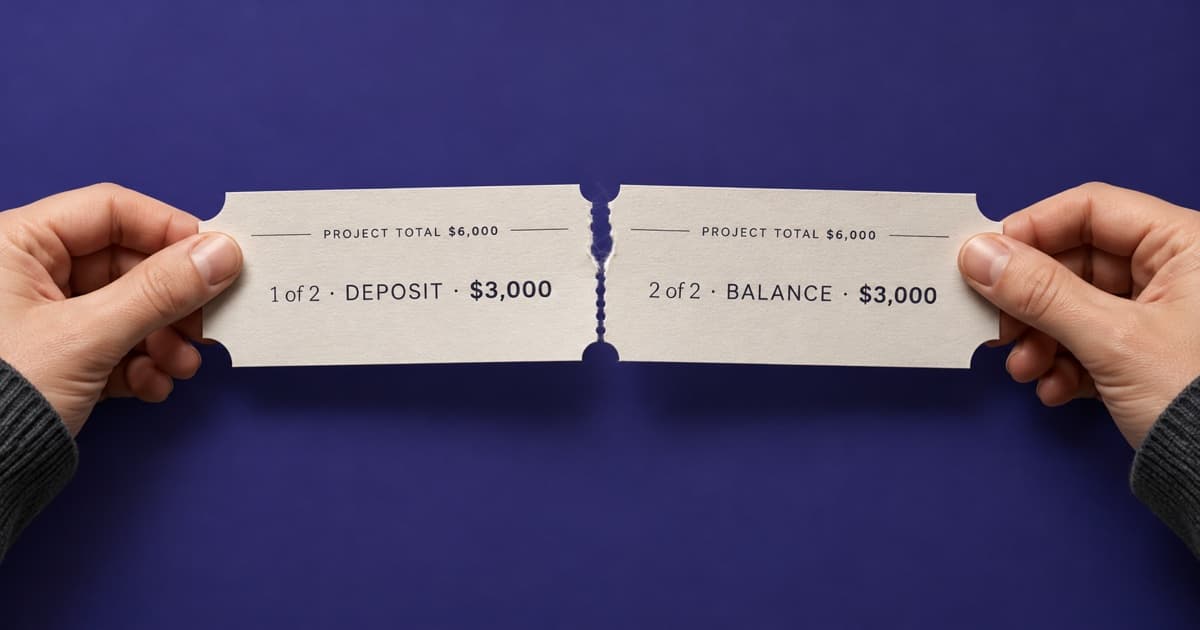
You agreed on 50/50. The client is ready to start. Now you're in your invoicing tool wondering what the deposit invoice should say, and how the final invoice should account for money already paid.
Collecting the deposit is straightforward. The paperwork is where it falls apart: two invoices that don't match, math that doesn't reconcile, and a final bill that looks like you're charging twice.
This guide walks through the full workflow: the deposit invoice, recording payment, and a final balance invoice that references the deposit correctly.
One Invoice or Two?
Decide this before you create anything.
Two separate invoices: a deposit invoice before work starts, then a final balance invoice on delivery. Each gets its own number, due date, and line items. Usually the cleaner option, because each document maps to one payment.
One invoice with partial payment recording: one invoice for the full project total. When the deposit clears, you record it as a partial payment and the remaining balance stays on the same invoice. Works when your tool handles partials well and the client doesn't need separate documents for each payment.
| Situation | Often a good fit |
|---|---|
| New client, first project together | Two separate invoices (clear paper trail for both sides) |
| Corporate client with PO-based AP | Two separate invoices (confirm whether they need one PO per invoice or one PO for the full project) |
| Repeat client, simple project | Either works; some accounting tools handle one invoice with partials cleanly |
| Your tool doesn't track partials easily | Two separate invoices |
| Client prefers one reference document | One invoice with partial recording |
For the one-invoice path, see Partial Payments on Invoices for recording and tracking mechanics.
The rest of this guide covers the two-invoice approach, since it gives both sides the clearest paper trail.
How to Build the Deposit Invoice
The deposit invoice is a real invoice with real payment obligations. Not a quote, not a proforma, not a placeholder.
What to include
- Your business details and the client's billing contact (same as any standard invoice; see How to Create a Professional Invoice for the full checklist)
- Invoice number in your standard series (e.g., INV-2026-047). Skip a separate "deposit" prefix. This is a regular invoice. For numbering guidance, see Invoice Numbering Best Practices.
- Date issued and due date (typically Due on Receipt or Net 7 for deposits)
- Line item(s) describing the deposit clearly
- The total project amount for context, so the client sees the deposit against the whole fee
- Payment terms and accepted payment methods
Sample deposit invoice
For a $6,000 project with a 50/50 split:
| DEPOSIT INVOICE | |
|---|---|
| Invoice | INV-2026-047 (1 of 2) |
| Description | Website Redesign — 50% deposit |
| Per agreement dated | [date] |
| Total agreed project fee | $6,000 |
| Amount due | $3,000 |
Both short and detailed formats work. Hit four things: name the project, label it a deposit, show the project total, and make the amount due obvious.
What to say in the email
Hi [Name],
Attached is the deposit invoice for [project]. Once this clears, I'll begin work per our agreement.
Let me know if you have any questions.
For more on structuring invoice emails, see How to Email an Invoice to a Client.

Between the Deposit and Final Invoice
Two steps before you send the final bill.
1. Wait for the deposit to clear before starting work. That's the whole point of requiring one. Start early and the deposit stops protecting you. For why this matters, see Upfront Deposits: Why Freelancers Should Never Work for $0 Down.
2. Record the deposit as soon as it lands. Log the payment date and amount in your invoicing tool immediately. Don't wait until project close to reconcile. If your tool supports it, mark the deposit invoice paid and confirm receipt to the client.
How to Build the Final Balance Invoice
This is where deposit billing usually breaks. The common mistake: a second invoice for the full project amount with no reference to the deposit. AP sees $6,000 instead of $3,000 owed, and you end up fielding a confused email or a duplicate payment request.
What to include
Everything a standard invoice needs, plus:
- A reference to the deposit invoice by number
- A deposit credit line or note showing the amount already paid
- The remaining balance due as the invoice total
Two ways to structure the final invoice
Option A: Invoice only the remaining balance. Set the total to $3,000 and reference the deposit in the line-item description. Simplest approach; works in any invoicing tool.
| FINAL BALANCE INVOICE | |
|---|---|
| Invoice | INV-2026-048 (2 of 2) |
| Description | Website Redesign — Final balance |
| Deliverables submitted | [date] |
| Total agreed project fee | $6,000 |
| Deposit paid (INV-2026-047) | $3,000 |
| Amount due | $3,000 |
Option B: Show the full project total with a deposit credit. Some accounting workflows want the full amount on the final invoice with the deposit subtracted. If your tool has a dedicated deposit, prepayment, or credit-application feature, use that to apply the previously recorded deposit against the final invoice:
Website Redesign — Complete Project Total project fee: $6,000 Less: Deposit applied (Invoice #INV-2026-047, [date]): -$3,000 Balance due: $3,000
Not all tools support this format. If yours doesn't, Option A beats a workaround. Don't use a generic discount field to represent a deposit. Discounts and prepayments are different accounting concepts, and misclassifying them can affect your books and tax records.
Either way, one document should answer three questions: what was the total, what was already paid, and what's left.
A note on taxes
Tax treatment of deposits varies by location. In some jurisdictions, collecting or invoicing a deposit can trigger tax obligations (VAT, GST, or sales tax) before the project is complete. In others, the tax point is delivery. Check the rules that apply to your situation and confirm with your accountant how advance payments should be recorded in your books.
Due date on the final invoice
Many freelancers use Due on Receipt for the deposit and Net 7 or Net 15 for the final balance. Match whatever terms you agreed to in your contract. For term options, see Invoice Payment Terms Explained.
Create separate deposit and balance invoices in minutes.
BillerBear lets you send numbered invoices for each payment stage, record deposits as they clear, and track payments and outstanding balances on each invoice with automated reminders.
Create a free invoice →When Corporate Finance Needs a Proforma First
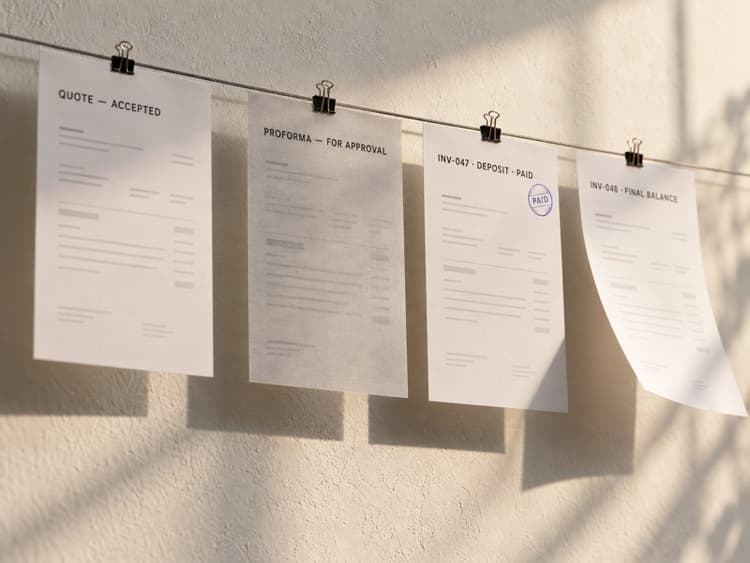
Some corporate clients need a proforma invoice before they can issue a purchase order or approve a budget line. In a deposit workflow, the sequence looks like this:
- Quote accepted
- Proforma for the full project total (for PO/budget approval)
- Deposit invoice (for actual payment)
- Work begins after deposit clears
- Final balance invoice on delivery
The proforma previews the total cost. The deposit and final invoices collect the actual payments. Keep proformas in a separate number series from regular invoices, and do not convert the proforma into an additional $6,000 invoice if you already issued the deposit and final balance invoices. The proforma is for approval only; it should never create a third billing document.
For proforma details, see Proforma Invoice for Freelancers.
Timing: When to Send Each Invoice
- Deposit invoice: Right after the client accepts your quote or signs the agreement. Collect payment before work begins.
- Final balance invoice: On delivery, on approval, or at whatever trigger your contract specifies.
For timing rules by project type, see When to Send an Invoice as a Freelancer.
Common Deposit Invoicing Mistakes
Sending the final invoice for the full project total. If the final invoice says $6,000 instead of $3,000, the client sees a number that doesn't match what they owe. Show the deposit credit or invoice only the remaining balance.
Not referencing the deposit invoice number on the final invoice. Without a cross-reference, AP has to dig through emails to connect the two payments. Include the deposit invoice number every time.
Starting work before the deposit clears. Once you begin without payment, that leverage is gone.
Using a separate numbering system for deposit invoices. Deposit invoices are real invoices. Use your standard series so they sit in the same audit trail as everything else.
Combining deposit and final into one invoice after the fact. If you already sent a deposit invoice, don't merge everything into one final invoice later. It creates reconciliation problems and confuses the client's records.
When Two Payments Aren't Enough
Large projects with three or more payment points tied to deliverables need a different structure. Switch to milestone billing: separate invoices for each phase, each tied to a specific deliverable.
See Milestone Billing for Freelancers for structures, contract language, and invoicing examples.
Frequently Asked Questions
Do I really need to send two separate invoices for a deposit and final payment? Not always. Two invoices give both sides a clearer paper trail, especially with new clients or corporate AP teams. But if your invoicing tool handles partial payments well and the client prefers a single reference document, one invoice with the deposit recorded as a partial payment works fine. Choose whichever approach your workflow and the client's accounting process support best.
How do I show that a deposit was already paid on the final invoice? The simplest method is to invoice only the remaining balance and reference the deposit in the line-item description, including the deposit invoice number and amount. If your accounting software has a dedicated deposit or prepayment feature, you can show the full project total and apply the deposit as a credit. Either way, the client should be able to see the total, what was paid, and what's left from one document.
Do I need to charge tax on a deposit invoice? It depends on your jurisdiction. In some locations, tax is due when payment is collected or invoiced, even before the project is complete. In others, the tax point is delivery. Check your local sales tax, VAT, or GST rules. When in doubt, consult your accountant.
The Workflow in Four Steps
Deposit-plus-balance billing is standard in freelancing. When the paperwork matches the payments, nobody has to ask "did I already pay for this?"
- Send the deposit invoice.
- Collect and record the deposit before starting work.
- Do the work.
- Send the final balance invoice with the deposit credited and both invoice numbers referenced.
With BillerBear, you can create separate deposit and balance invoices with their own numbers and due dates, record each payment as it arrives, and track payments and outstanding balances on each invoice until the project is fully paid. Create your first invoice free →
Ready to create clearer invoices?
Create up to 3 invoices per month free. No credit card required.
BillerBear Editorial
Continue reading
Invoice Line Item Descriptions: Examples and a Copyable Formula
Use a practical invoice line-item formula, before-and-after examples by service type, and wording that matches the scope your client approved.
What Business Name Goes on a Freelance Invoice? LLC, DBA, and Legal Name Explained
Not sure whether to invoice under your legal name, LLC, or DBA? Learn what belongs in your invoice header, how it should connect to your W-9, and how to prevent vendor setup and AP delays.
When to Send an Invoice as a Freelancer: Timing Rules by Project Type
Learn when freelancers should send project, hourly, milestone, retainer, and corporate invoices, and avoid delays before payment terms even begin.