

You send a $4,000 quote. The reply comes back in an hour: "Looks great. Any flexibility on price? Could you do $3,000?"
Most freelancers react in one of two ways. They cave to keep the project, or they refuse and hope the client doesn't walk. Neither is a plan.
When a client asks for a discount, the right answer depends on two things: why they're asking and when. A request before you've quoted is a budget conversation. The same request after the invoice is something else entirely. Here's what to say at each stage, plus the trades worth asking for if you do say yes.
The short version:
- Same work, lower price? Hold the price.
- Smaller budget? Reduce the scope.
- Cash-flow problem? Change the payment terms.
- Work already delivered and invoiced? Point back to what you agreed.
First, Figure Out What the Request Actually Means
"Can you do it cheaper?" sounds like one question. It's usually one of four:
- A real budget ceiling. The client has $3,000 approved and can't go higher without another round of approvals. This is solvable, usually by changing scope.
- A negotiation reflex. Some clients ask every vendor for a discount because it sometimes works. They may accept your original price if you hold it politely.
- A value gap. They don't see why the work is worth $4,000 yet. A lower price won't fix that. A clearer outcome usually will.
- A warning sign. The ask comes with pressure: "We'll have lots more work for you later," or "Other freelancers charge half this." That pattern deserves caution, which we cover in 5 Client Red Flags That Predict Payment Problems.
One question usually tells you which: "What budget are you working with for this?" A client with a real ceiling can often give you a number. A client who asks out of habit may drop the request.
Before You Quote: Anchor the Price to Scope
Handle it before it happens. If the client mentions budget early ("We're hoping to keep this under $3,000"), you haven't locked in a number yet, so shape the scope to their budget instead of cutting your rate.
Two approaches work well here:
- Offer tiers. Present two or three versions of the project at different price points, each with a clearly different scope. The client picks a level instead of negotiating your rate. If you already sell packages, Productized Services for Freelancers covers how to structure them.
- Quote the full scope, then show what a smaller version costs. "The full site with six pages is $4,000. A three-page launch version is $2,600, and we can add the remaining pages later."
Either way, the price is tied to what's delivered. If you haven't settled on your baseline rate yet, start with How to Set Freelance Rates for the First Time so you know your floor before the conversation starts.
After the Quote: Cut Scope, Change Terms, or Hold
Most discount requests show up here. You've sent a number, and the client wants a lower one. You have three options.
Option 1: Reduce scope to match the budget
Remove work, not value per hour. This keeps your rate intact and gives the client a real choice.
"I can hit $3,000 if we drop the blog template and cap revisions at one round. Everything else stays. Want a revised quote?"
Option 2: Adjust the terms instead of the price
Sometimes the client's issue is cash timing, not the total. Splitting payments can make the full price workable.
"Total stays $4,000. I can split it into a $1,500 deposit and two milestone payments if that helps with cash flow."
Milestone Billing for Freelancers shows how to structure those payment points.
Option 3: Hold the price
If the quote reflects the work, it's fine to say so. You don't need to justify every line.
"The quote matches the scope we discussed, so I can't lower it for the same deliverables. If budget's the blocker, I can outline a smaller version."
Holding your price isn't refusing to help. Offer a scope alternative in the same message so the conversation keeps moving. For the reasoning behind defending value rather than hours, see The Psychology of Pricing.
Put the revised scope and price in writing.
BillerBear lets you create a proforma invoice with the agreed line items and total, then convert it to a final invoice when it's time to bill.
Create a free invoice →Mid-Project: Price the Change, Not a Markdown
Mid-project asks often don't sound like discount requests. The client asks for something extra and expects it to be included, or they suggest the final payment should be lower because "it ended up simpler than we thought."
Treat both the same way: go back to the agreed scope.
- If they want more work at the same price, that's scope creep. Write up a change order with the added cost, or offer to swap out something already planned.
- If they want to pay less because the project felt easier, and you quoted a fixed price, remember that you priced the outcome, not the effort. "We priced the deliverables we agreed on. Those are on track."
How to Bill for Scope Creep has more wording for the "just one small change" requests that often come with these conversations.
After the Invoice: A Discount Request Is Not a Dispute
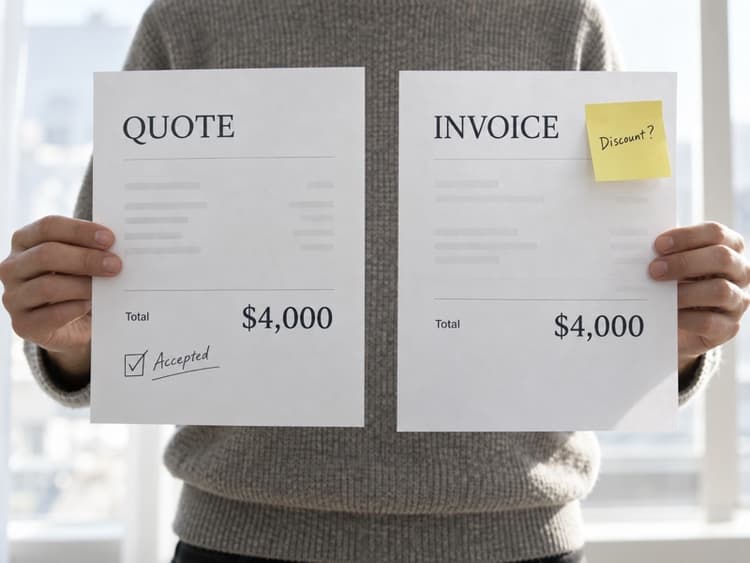
A client who asks for a discount after the invoice lands, with no complaint about the work, wants to renegotiate a price they already accepted. You don't have to agree. If the client accepted a quote or agreement that clearly set the scope and price, that is the amount you both agreed to.
"The invoice matches the quote we agreed on in [month]. I can't adjust it, but I'm happy to walk through line items if anything's unclear."
Ask yourself: unhappy with the work, or just the number?
If they say a deliverable was missing, late, or below what was agreed, that's a dispute, not a discount request. Handle it with the process in What to Do When a Client Disputes an Invoice. If you agree to a reduction after the invoice is sent, document the change rather than letting the client simply underpay. Depending on your accounting setup and local rules, that may mean replacing or revising the invoice, or issuing a credit note (also called a credit memo). How to Correct an Invoice After Sending It walks through the options.
If You Say Yes, Trade Something for It
Sometimes a discount is the right business call: a client you want long-term, a portfolio piece in a new niche, a slow month. Don't give a discount for nothing. Ask for something in return that has real value to you.
| If you offer... | Ask for... |
|---|---|
| A lower project price | Payment in full upfront, or a larger deposit |
| A reduced monthly rate | A longer commitment, such as a 6-month retainer |
| A one-time discount | Permission to use the project as a case study, plus a testimonial |
| A lower fee for a new niche | A referral introduction or a defined portfolio credit |
| Flexibility on price | A looser deadline that fits your schedule |
There's also a discount you can offer on your own terms: a small reduction for paying quickly. That's a separate decision with its own math, covered in Early Payment Discounts for Freelancers.
Two more guardrails:
- Make it explicitly one-time. "I can do $3,500 for this first project. Future work will be at my standard rate." Without that sentence, the discounted price can quietly become the new baseline.
- Put it in writing. Include the original price, the discount, and what the client agreed to in exchange in your quote or contract.
How to Show the Discount on the Invoice
If you agree to a discount, don't just lower your line-item prices. Bill the full amount for each line item, then apply the discount as its own adjustment. That keeps your real rate on record, so the next invoice at full price doesn't look like a price increase.
A clean discounted invoice looks like this:
- Website design and development: $4,000
- Discount (12.5%): −$500
- Total due: $3,500
If you charge sales tax or VAT, how a discount affects the taxable amount varies by jurisdiction and by the type of discount. Confirm the treatment with your accountant or tax authority.
Keep your full rate visible, even when you discount.
BillerBear lets you apply a percentage or fixed-amount discount at the invoice level. It appears as its own line below the subtotal, so clients see your full price and the reduction separately.
Create a free invoice →How to Say No to a Discount Without Losing the Client
A good refusal does three things: it's warm, it's brief, and it gives the client a next step. Here's a template you can adapt:
Hi [Name],
Thanks for flagging budget. The quote matches the scope we discussed, so I can't reduce the price for the same work.
If $3,000 is the limit, here's what I could deliver within it: [smaller scope]. Or we can keep the full scope and split payment into three installments.
Happy to move either way. Which works for you?
Skip the apology tour, the rate breakdown, and the comparison to other freelancers. Over-explaining makes the price sound negotiable.

When to Walk Away
Not every client is worth keeping. Consider declining the project if:
- The client asks for a discount at every stage, before the quote, after it, and again on the invoice.
- The discount would push the project below what you need to earn to cover your time and costs.
- The request comes with pressure tactics, like deadlines to accept or promises of future work in exchange for a low price now.
- They won't accept any scope reduction and just want the same work for less.
Repeated price pressure can be a warning sign of friction at payment time. If several of these apply, passing may cost you less than chasing the invoice later.
When a client asks for a discount, you're rarely choosing yes or no on the rate. You're choosing scope, terms, or walking away. Change the work or the payment structure. Keep the rate.
Ready to create clearer invoices?
Create up to 3 invoices per month free. No credit card required.
BillerBear Editorial
Continue reading
Productized Services for Freelancers: How to Price Packages and Invoice Them Clearly
Turn repeat freelance work into fixed packages with clear scope, tiered pricing, and invoices that match what clients bought.
How to Track Billable Hours as a Freelancer (Before You Invoice)
Stop billing from memory. Learn how to track billable hours during the work, sort billable vs. non-billable time, and turn your log into clean invoice line items.
Hourly vs. Flat Rate Invoicing: How to Bill Clients Clearly
Compare hourly and flat-rate freelance billing, then learn how to itemize each model on your invoice with line-item examples and mistakes to avoid.