
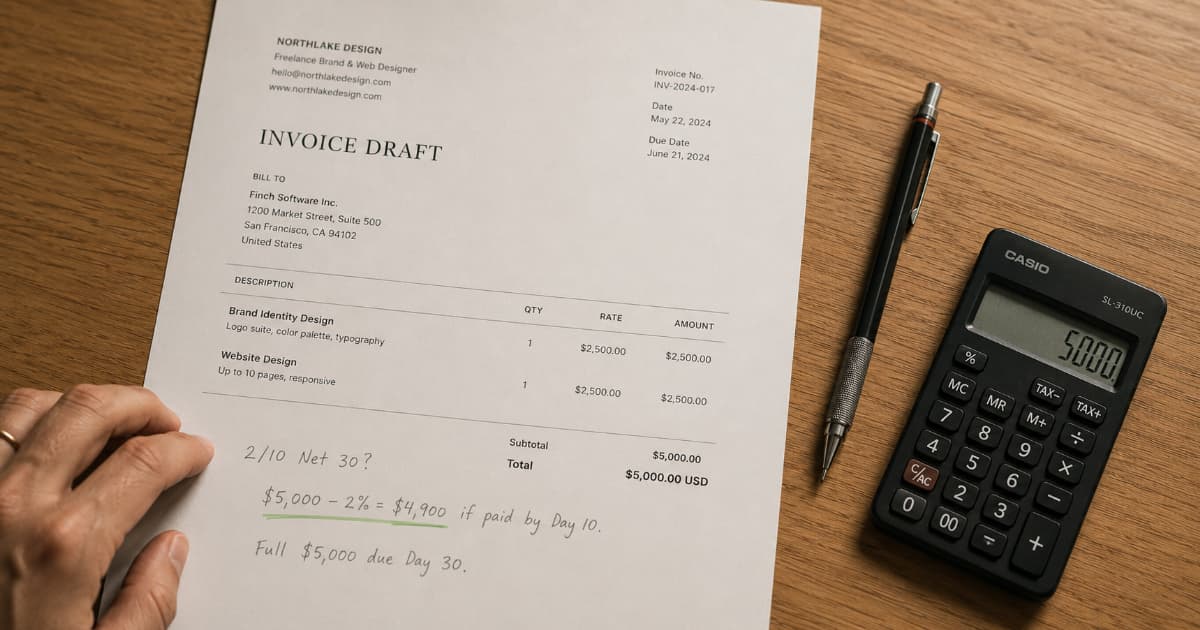
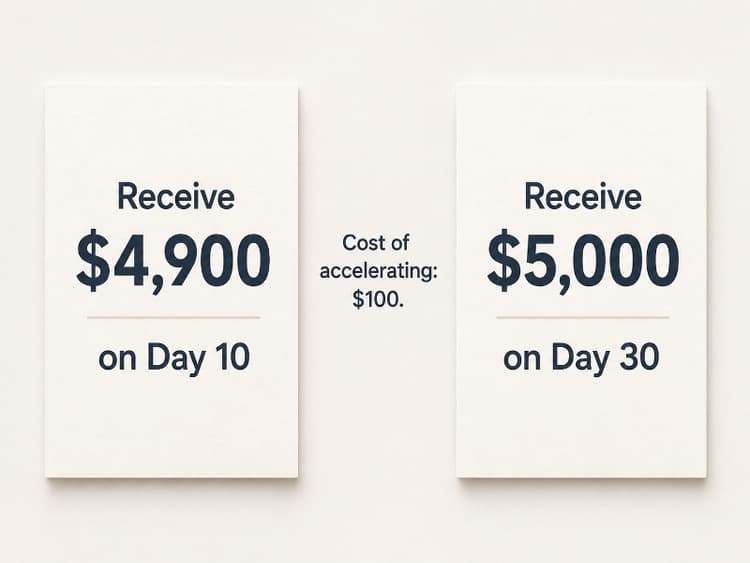
You are about to send a $5,000 invoice on Net 30. Waiting a full month will make next week's expenses tight, so you consider adding an early-payment discount: accept $4,900 by Day 10, or wait for the full $5,000 on Day 30.
That instinct makes sense. Early-payment discounts reward clients for paying before the due date instead of penalizing them for paying late. They are a standard business tool.
But 2% off sounds trivial until you annualize it. Whether the trade is worth it depends on your margins, your cash position, and whether the client would have paid quickly anyway.
What 2/10 Net 30 Means
The shorthand works like this:
2/10 Net 30 = the client gets a 2% discount if they pay within 10 days. Otherwise, the full amount is due in 30 days.
Other variations exist: 1/10 Net 30 (1% for 10-day payment), 2/10 Net 45, or any combination that fits the relationship.
For a full breakdown of Net terms, see Invoice Payment Terms Explained. This post is about whether the discount makes financial sense for you.
The Real Cost: Annualized Math
A 2% discount does not feel like much on one invoice. You are not simply giving up 2%. You are giving up 2% to receive payment 20 days early (the gap between Day 10 and Day 30).
Here is the standard formula:
Annualized cost = (Discount ÷ (1 − Discount)) × (365 ÷ Days accelerated)
For 2/10 Net 30:
(0.02 ÷ 0.98) × (365 ÷ 20) = 37.2% annualized
That does not mean you are literally taking out a loan at 37.2% APR. It is a comparison tool that shows how expensive it is to give up $100 in exchange for receiving $4,900 twenty days earlier.
| Terms | Discount | Days accelerated | Annualized cost |
|---|---|---|---|
| 2/10 Net 30 | 2% | 20 | 37.2% |
| 1/10 Net 30 | 1% | 20 | 18.4% |
| 2/10 Net 45 | 2% | 35 | 21.3% |
| 1/10 Net 45 | 1% | 35 | 10.5% |
These figures assume the client would otherwise pay on the net due date. If they typically pay late, the annualized equivalent is lower because you are accelerating payment by more than 20 days. The dollar cost of the discount is still the same.
The numbers look steep. They should. Annualized cost is not the whole story. The question is whether 20 extra days of cash in your account is worth more than the discount you give up.
When Offering a Discount Makes Financial Sense
Early payment discounts work when the cost of not having the money exceeds the discount itself.
You have a short-term cash gap. If receiving the money 20 days earlier prevents costs greater than the discount itself, such as a missed-payment penalty, an expensive cash-advance fee, or losing a project because you cannot cover upfront costs, the trade may make sense. Compare the exact dollar cost first. On a $5,000 invoice, the discount costs $100. Borrowing $4,900 for 20 days at 24% APR costs about $64 in interest before fees, so the discount would actually be the more expensive option in that example. It becomes attractive only when the total cost of waiting or borrowing exceeds the $100 you are giving up.
The client routinely pays late. Some clients treat Net 30 as Net 45. If offering 2/10 Net 30 converts a chronic late payer into a 10-day payer, you get the money faster and cut the follow-up cycle. That time has a cost too.
The invoice is large enough for the discount to matter to the client. A 2% discount on a $500 invoice is $10. Many AP departments will not restructure their process for $10. On a $15,000 invoice, $300 gets attention.
You are working with a corporate AP team that has early-pay discretion. When a client runs an early-pay program or has discretion over payment timing, your discount offer can give their AP department a financial incentive to prioritize your invoice over others in the same payment run.

When Early Payment Discounts Do Not Make Sense
The client already pays fast. If a client consistently pays within 10–15 days on Net 30 terms, a discount gives away margin for behavior you were already getting for free.
Your margins are thin. On a project where your effective rate is $75/hour across 60 hours, a 2% discount on a $4,500 invoice is $90. If profit on that project was already tight, the discount comes straight off the bottom.
You would offer the discount on every invoice. Early payment discounts work as a selective lever. Apply them to all clients by default and you have reduced your rate by 2% and called it a discount.
The client is likely to take it every time. Some corporate clients have policies to take every early-pay discount offered. If you bill that client monthly, you have permanently reduced revenue from that relationship by 2%.
An early-payment discount is one you choose to offer. If the client is the one asking for a lower price, that's a different conversation, covered in Client Asks for a Discount? How to Respond at Every Stage.
Discounts vs. Other Cash Flow Levers
Before defaulting to discounts, consider whether a different structure solves the same problem without cutting your rate.
Shorter payment terms. Switching from Net 30 to Net 15 gets you paid sooner without giving up revenue. When you can negotiate it, shorter terms tend to beat discounts. See How to Write Payment Terms That Prevent Delays.
Upfront deposits. A 30–50% deposit on project start puts cash in your account before delivery. This works especially well for new clients or large projects where Net 30 creates real exposure. See Upfront Deposits: Why Freelancers Should Never Work for $0 Down.
Milestone billing. Breaking a project into paid milestones creates multiple smaller payment events instead of one large invoice at the end. See Milestone Billing for Freelancers.
Late fees. If the problem is chronic late payment rather than slow terms, a late fee policy might change behavior without costing you revenue. See Should Freelancers Charge Late Fees?.
Discounts are a carrot. Late fees are a stick. Deposits and milestones restructure the timeline. Match the tool to the problem.
Set clear due dates and follow up automatically.
BillerBear supports invoice-level discounts, clear due dates, and reminders on the due date and when overdue.
Create a free invoice →How to Write Discount Terms on Your Invoice
If you offer a discount, the terms need to be explicit. Ambiguous language can lead to clients taking the discount and paying late anyway.
State the terms clearly in the payment terms section or payment instructions:
Payment terms: 2/10 Net 30. A 2% discount applies if payment is received within 10 days of the invoice date. Full payment is due within 30 days.
Ideally, include the discount terms in your contract, quote, purchase order, or another written agreement before invoicing. Adding new terms only to the invoice can create confusion, especially if the client takes the discount after the deadline. See Freelance Contracts That Actually Protect Payment for contract structure.
If a client takes the discount but pays on Day 18, decide in advance whether to enforce the full amount or let it slide. Inconsistent enforcement undermines the terms.
Tax note: Early-payment discounts can affect the taxable invoice amount or require a credit note in some jurisdictions, particularly when VAT or similar taxes apply. Confirm the correct treatment with your accountant or local tax authority.
Asking About a Client's Early-Pay Program
Some corporate and enterprise clients run their own early-payment programs. The company offers to pay you early in exchange for a discount, often through a third-party platform or dynamic discounting tool.
Before offering your own discount terms, ask during client onboarding:
"Does your AP department offer an early-payment program or accelerated payment option for vendors?"
If they do, compare their terms to what you would offer independently. A client program might pay you in 5 days for 1.5%, while your self-managed terms are 2/10 Net 30. The client's program could be the better deal.
For how corporate AP processes work and when to raise these questions, see How to Invoice Corporate Clients.
Run the Numbers Before You Offer
Early payment discounts are a legitimate cash flow tool, not a default setting. Use them selectively: on large invoices, with slow-paying clients, or during cash crunches where 20 extra days of liquidity matters more than 2% of revenue.
Before you offer a discount, check two things. First, would shorter terms, a deposit, or milestone billing solve the same timing problem without reducing your rate? Second, is this client likely to pay fast anyway?
If both answers are no, the discount might be the right move. If either is yes, keep your full rate and use a structural fix instead.
To see how early payment terms affect your overall cash timing, map them into a 90-day cash flow forecast. And to track whether clients actually respect the discount window, keep a clean accounts receivable ledger so you are not guessing.
Ready to create clearer invoices?
Create up to 3 invoices per month free. No credit card required.
BillerBear Editorial
Continue reading
Client Says They Paid Your Invoice but You Haven't Received It: What to Do Next
When a client insists they've paid but your bank shows nothing, don't argue and don't mark it paid. Here's a verification-first workflow to diagnose the gap and resolve it.
How to Set Up an Invoice Payment Plan That Protects Your Cash Flow
When a client can't pay the full invoice at once, a structured payment plan can recover the revenue. Here's how to decide when a plan makes sense, what to put in writing, and how to invoice each installment.
Net 60 Payment Terms? How to Negotiate Faster Payment as a Freelancer
When a corporate client sends a vendor agreement with Net 45 or Net 60, you don't have to accept it as-is. Counter-offers, scripts, and what AP teams sometimes accept.