

A new corporate client sends a vendor agreement. Scope looks right. Rate is fair. Then you hit the payment terms: Net 60.
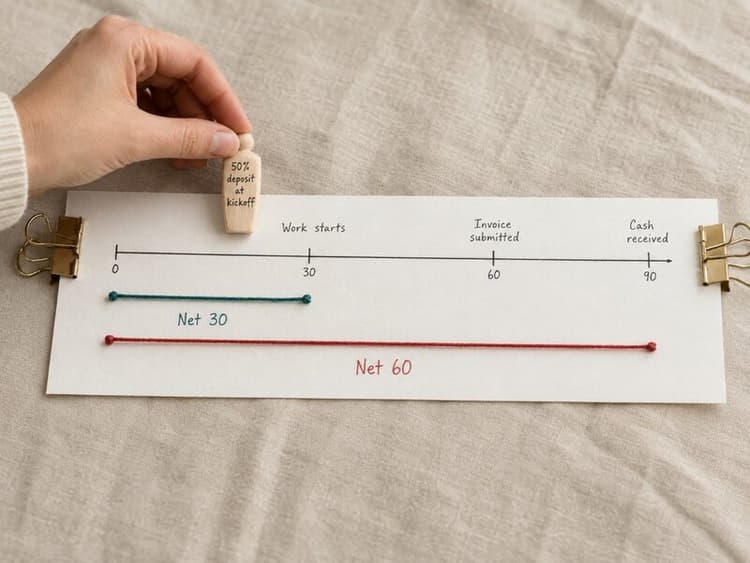
You deliver, invoice, and wait two months before money moves. A three-week project can mean nearly three months from first working day to first dollar received.
Net 60 is common in corporate procurement, especially at mid-market and enterprise buyers. It's often a default in the template, not a decision someone made about you. "Standard policy" still leaves room to negotiate. You don't have to absorb the cash-flow cost without a conversation.
If you need a refresher on what Net terms mean, see Invoice Payment Terms Explained. For how corporate AP processes work from the submission side, see How to Invoice Corporate Clients. This post is about what to do when the terms on the table are longer than you can afford.
The Cash-Flow Cost of Saying Yes
Before you respond, put a number on what Net 60 costs you.
Take an $8,000 project with no deposit. Work takes three weeks. Payment arrives 60 days after invoicing. You're floating $8,000 for roughly 81 days. Rent, software, subcontractors, and taxes don't pause during that window.
This isn't about the client being unreliable. It's timing. Net 60 turns every project into a short-term loan you extend to the client at zero interest.
For a full framework on mapping these gaps into your finances, see Freelance Cash Flow Forecasting: A 90-Day Plan.
When the Clock Actually Starts
Before negotiating, confirm one detail that can add days to your wait: when does the Net 60 countdown begin?
Common triggers:
- Invoice date: the date printed on your invoice
- Invoice receipt: the date AP receives and logs it
- Invoice approval: the date the internal approver signs off
The gap between these can be significant. Say you invoice on June 1, AP receives it June 5, and approval happens June 12. If the term starts at approval, your effective wait from invoice date isn't 60 days. It's 71.
Ask directly: "Does the payment term start from the invoice date or the approval date?" The answer affects when you submit, how you structure counter-offers, and how you plan follow-up.
Counter-Offers AP Teams Sometimes Accept
"Net 60 is our standard policy" is the line most freelancers hear. It's also where many stop pushing.
Some AP teams can approve exceptions, especially before the vendor agreement is signed. Payment terms are sometimes negotiable, particularly on smaller engagements or first-time vendor relationships. The counter-offers that move fastest are the ones that fit how AP already works.
Ask about an expedited payment track
Some companies run a separate process for smaller or urgent vendor invoices. Not every company has one, but it costs nothing to ask: "Does AP have an expedited payment option for vendors at this project size?"
Counter with Net 30
Net 30 is the most natural counter-offer, and worth asking for plainly. Some companies will move to Net 30 if you request it before signing, especially on first-time or smaller engagements. The worst they can say is no, and asking establishes that you're paying attention to terms.
Accept Net 60 with a deposit and milestone structure
If Net 60 won't budge, change what happens before the clock starts. A 30–50% deposit before work begins, with the remaining balance invoiced on Net 60 at delivery, may be an alternative worth proposing. Instead of asking procurement to override its standard payment term, you're changing how much of the project is exposed to that waiting period.
For how deposit structures work, see Upfront Deposits: Why Freelancers Should Never Work for $0 Down. For milestone splits, see Milestone Billing for Freelancers.
Offer an early-payment discount
A 2/10 Net 60 term (2% off if paid within 10 days) gives AP a financial reason to pay within the discount window, if their process can hit it. This works better when the invoice is large enough for the discount to matter. On a $2,000 invoice, $40 is unlikely to change behavior. On a $12,000 invoice, $240 might.
For the annualized math on whether discounts are worth offering, see Early Payment Discounts for Freelancers.
Quick reference: matching counter-offers to pushback
| Client says | You propose |
|---|---|
| Net 60 required | Net 30 |
| Net 60 cannot change | 40% deposit + Net 60 balance |
| Deposit not allowed | Milestone billing |
| Won't shorten Net 60 | Early-payment discount (e.g. 2/10 Net 60) |
| Nothing negotiable | Adjust rate or reconsider the project |
Price the float into your rate
If terms genuinely can't move, adjust your rate to reflect the cost of waiting. You're not adding a "Net 60 surcharge." You're pricing the project accurately, including the financing cost. This works better as a silent adjustment to your quote than a visible line item.
Scripts for the Conversation
Negotiating payment terms is different from negotiating scope or rate. You're usually talking to procurement or finance, not your project sponsor. Keep the language practical and specific.
To your project sponsor (before the contract is signed)
Hi [Name],
Everything in the vendor agreement looks good. One thing I'd like to discuss: payment terms are listed as Net 60. My standard terms are Net 30, and that works well for projects at this scale.
Would it be possible to adjust to Net 30, or would a deposit-plus-milestone structure work better on your end? I'm flexible on structure. I just want to make sure cash flow doesn't become a bottleneck during the project.
Happy to chat if a call is easier.
To procurement (replying to the vendor agreement)
Hi [Name],
Thank you for sending the vendor agreement. I've reviewed the terms and have one requested adjustment:
Section [X], Payment Terms: Requesting Net 30 in place of Net 60.
If Net 30 isn't available, I'd also be open to a deposit/milestone structure: 40% on signing, with the balance invoiced on Net 60 at delivery.
Please let me know if either option works, or if there's an expedited payment track for vendors at this project size. Happy to submit any additional forms needed.
When "we can't change the terms" comes back
Understood. I know payment terms can be hard to adjust once they're in the standard agreement. In that case, could we structure the engagement so I invoice 40% as a deposit before work begins, with the remaining 60% invoiced on delivery at Net 60?
That keeps the standard Net 60 term in place for the remaining balance while making the project workable from a cash-flow perspective.
Set due dates that match your negotiated terms.
BillerBear lets you set the due date on each invoice and sends automated reminders on the due date and when overdue.
Create a free invoice →When to Accept Net 60
Not every Net 60 is a deal-breaker. Accept it when:
- Project value justifies the wait and your cash reserves can cover the gap
- The client has a strong payment history. Net 60 from a company that pays on Day 58 every time is different from Net 60 treated as a suggestion
- The relationship has long-term potential. A first project on Net 60 that leads to recurring monthly work may be worth the initial float
- You've built the cost into your rate. If your quote already accounts for the extended timeline, the terms are priced in
When to Walk Away
Net 60 combined with other signals can point to a client that will be chronically difficult to collect from.
Walk-away signals:
- Net 60 or longer, plus no deposit and no milestone structure allowed
- The client rejects every structural alternative you propose
- Payment terms are vague or keep shifting during negotiation
- Scope is undefined but terms are rigid
For more on evaluating client risk before you commit, see 5 Client Red Flags That Predict Payment Problems.

Negotiate Before You Start
Discuss payment terms before work begins, not after the first invoice stalls.
If you're reviewing a vendor agreement now, ask these questions before you sign:
Pre-sign checklist
- Can the term be shortened to Net 30?
- If not, is a deposit or milestone structure available?
- Does AP have an expedited track for smaller vendors?
- When does the payment clock start, invoice date or approval date?
- Is an early-payment discount program available?
Get the answers in writing. Add the agreed terms to your contract. For contract language that protects your payment terms, see Freelance Contracts That Actually Protect Payment. And for how to write terms that stick, see How to Write Payment Terms That Prevent Delays.
Then invoice with confidence. Set the due date on each invoice to match the negotiated Net 30, Net 60, or milestone terms, and let BillerBear handle reminders on the due date and after it passes.
Ready to create clearer invoices?
Create up to 3 invoices per month free. No credit card required.
BillerBear Editorial
Continue reading
Client Says They Paid Your Invoice but You Haven't Received It: What to Do Next
When a client insists they've paid but your bank shows nothing, don't argue and don't mark it paid. Here's a verification-first workflow to diagnose the gap and resolve it.
How to Set Up an Invoice Payment Plan That Protects Your Cash Flow
When a client can't pay the full invoice at once, a structured payment plan can recover the revenue. Here's how to decide when a plan makes sense, what to put in writing, and how to invoice each installment.
Early Payment Discounts for Freelancers: Is 2/10 Net 30 Worth It?
A 2% early-payment discount can equal a 37.2% annualized cost. Learn when 2/10 Net 30 improves freelance cash flow—and when it only cuts margin.