
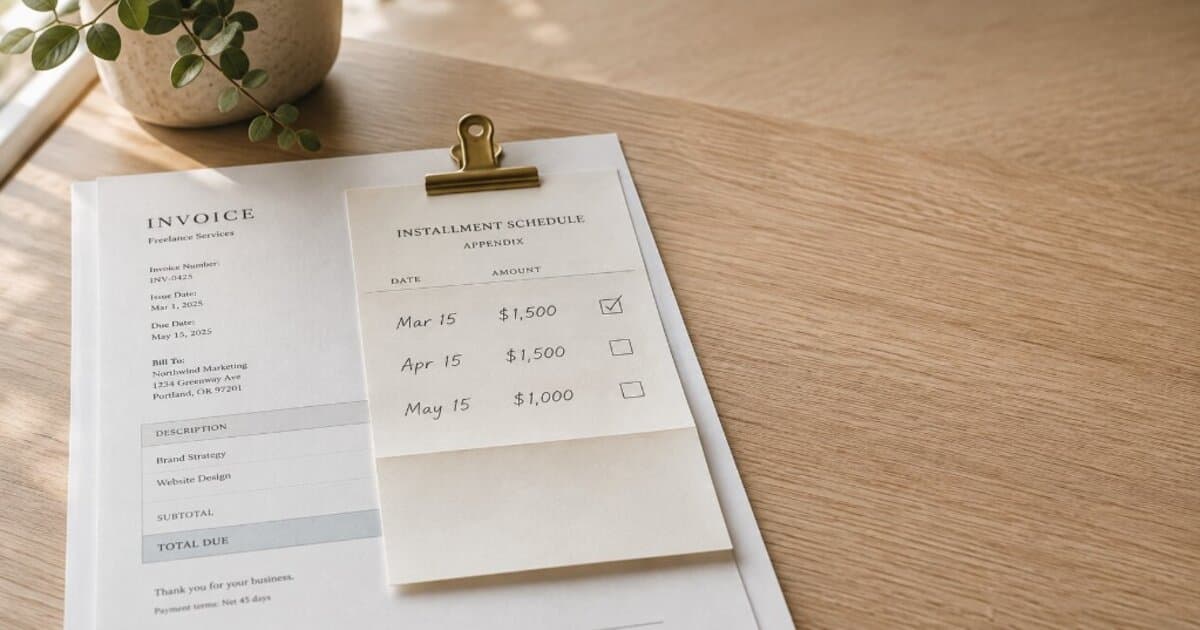
Your client owes you $4,000. They want to pay, but not all at once. They suggest "splitting it up over a few months."
You say yes because slow payment beats no payment. But nothing goes in writing: no schedule, no late-installment policy, no paper trail. Just a verbal agreement and hope.
Three months later, they've paid $1,500 and gone quiet.
A payment plan can save the relationship and recover revenue you'd otherwise write off. It only works if you treat it like a business agreement, not a favor.
When to Offer a Payment Plan (and When to Refuse)
Not every late-paying client deserves an invoice payment plan. Plans fit clients who are willing to pay but temporarily can't cover the full balance. They don't replace collections when someone is avoiding you.
Good candidates for a payment plan:
- A client who usually pays on time but hits a cash crunch on one large invoice
- A new project where the total is high enough that splitting it reduces risk for both sides
- A client who asks to pay in installments before work begins
- An overdue invoice where the client responds, acknowledges the debt, and asks for help
When to skip the plan and escalate instead:
- The client ignored multiple reminders and only responds when you mention consequences
- They broke a previous payment plan
- The amount is small enough that a plan creates more admin work than it's worth
- They dispute the balance itself, not their ability to pay it
If the client is ghosting you, a payment plan isn't the right tool. See Freelancer Unpaid Invoice: What to Do When a Client Ghosts You. If they're contesting the charges, see What to Do When a Client Disputes Your Invoice.
What to Put in Writing
A verbal payment plan is hard to enforce because the terms are ambiguous and difficult to prove. If the client stops after the first installment, you have much weaker leverage and no paper trail if you need to escalate.
Every plan should include these elements in a written agreement (email confirmation at minimum; a signed contract addendum when possible):
1. The total amount owed. State the full balance so there's no ambiguity about what the plan covers.
2. The number of installments and amount of each. Example: "$4,000 total, payable in four monthly installments of $1,000." Avoid open-ended language like "pay what you can when you can."
3. Due dates for each installment. Use specific calendar dates, not "monthly" or "every few weeks." Example: "Installment 1 due October 1, Installment 2 due November 1, Installment 3 due December 1, Installment 4 due January 1."
4. What happens if an installment is missed. Most freelancers skip this. Without it, a missed payment has no defined consequence. Options include: the full remaining balance becomes due immediately, a late fee applies per installment, or work is paused until the missed payment clears. Include these terms in your original agreement or signed addendum; enforceability depends on your jurisdiction and whether the terms are reasonable.
5. Payment method. Specify how each installment should be paid. This cuts down on "I'll mail a check" delays.
6. Confirmation that the total balance is not disputed. The client agrees the amount is owed. That prevents them from accepting a plan and later claiming they never agreed to the full total.
For contract clauses that support this structure, see Freelance Contracts That Actually Protect Payment.

How to Invoice Installments
Two workable approaches. Pick one and stay consistent.
Approach 1: One Invoice, Multiple Partial Payments
Send one invoice for the full amount. As each installment arrives, record it as a partial payment against the original invoice. The invoice stays open until the balance hits zero.
When this works best:
- The full amount was already invoiced before the plan was agreed
- Your invoicing tool tracks partial payments with a visible remaining balance
- The client's AP team prefers one invoice number to reference
Example:
Invoice #INV-2026-091: $4,000 Payment 1 received (Oct 1): $1,000. Balance: $3,000 Payment 2 received (Nov 1): $1,000. Balance: $2,000
Each time you record a partial payment, the client can see what's left. For the mechanics of recording partials and communicating balances, see Partial Payments on Invoices.
Approach 2: Separate Invoices for Each Installment
Create individual invoices for each installment with their own numbers and due dates.
When this works best:
- The plan was agreed before any invoice was sent
- The client's accounting team processes each payment as a separate transaction
- You want each installment to trigger its own automated reminders
Example:
Invoice #INV-2026-091A: $1,000, due Oct 1 Invoice #INV-2026-091B: $1,000, due Nov 1 Invoice #INV-2026-091C: $1,000, due Dec 1 Invoice #INV-2026-091D: $1,000, due Jan 1
Reference the payment plan agreement in each invoice's line item description so it's clear these are installments against one total, not four separate charges. For clear line item language, see How to Write Invoice Line Item Descriptions.
This Is Not Milestone Billing
Both approaches involve multiple payments, but a payment plan splits a fixed total over time. Milestone billing ties payments to specific deliverables. On a payment plan, you might owe nothing new between installments. With milestones, each payment unlocks the next phase of work. If your project is structured around deliverables, see Milestone Billing for Freelancers instead.
Record partial payments and track the remaining balance.
BillerBear logs each installment against the original invoice, shows what's still owed, and sends automated reminders on the due date, 3 days overdue, and 10 days overdue.
Create a free invoice →How to Propose a Payment Plan Professionally
Whether you're offering proactively or responding to a client who can't pay in full, keep the language specific and focused on a solution.
When you're offering the plan
Hi [Name],
I understand the $4,000 total is a stretch right now. I'd like to offer a payment plan: four monthly installments of $1,000, starting October 1.
The schedule would be Oct 1, Nov 1, Dec 1, and Jan 1. If any installment is more than 7 days late, the full remaining balance becomes due immediately.
If that works for you, please reply confirming the schedule and I'll send the first invoice.
When the client asks for a plan on an overdue invoice
Hi [Name],
Thanks for letting me know about the cash flow situation.
Here's what I can offer: $4,000 split into three payments of $1,333, $1,333, and $1,334 on October 1, November 1, and December 1. If a payment is missed by more than 7 days, the remaining balance becomes due in full.
Please confirm in writing so I can update the billing schedule.
For follow-up templates at different stages of overdue, see How to Politely Ask for Payment.
Tracking a Payment Plan Without Losing Your Mind
A payment plan adds recurring follow-up to your workload. Without a system, you'll lose track of which installment is current and whether the client is on schedule.
Set up tracking before the first installment is due:
- Record the plan details in your invoicing tool or a spreadsheet: total owed, installment amounts, due dates, payments received, remaining balance
- If using separate invoices, schedule them ahead of time. Recurring invoices with a defined end date can automate fixed installment amounts
- Enable payment reminders so each installment gets a nudge on the due date and a follow-up if it's late
- After each payment arrives, update the balance and send a short confirmation
For automated reminders, see Automated Invoice Payment Reminders. For tracking open balances across clients, see Accounts Receivable for Freelancers.
What to Do When an Installment Is Missed
This is where verbal plans usually fall apart. The client misses one payment, you don't know what to say, and the plan quietly dies.
If your written agreement includes a missed-payment clause, you have a defined next step instead of guessing.
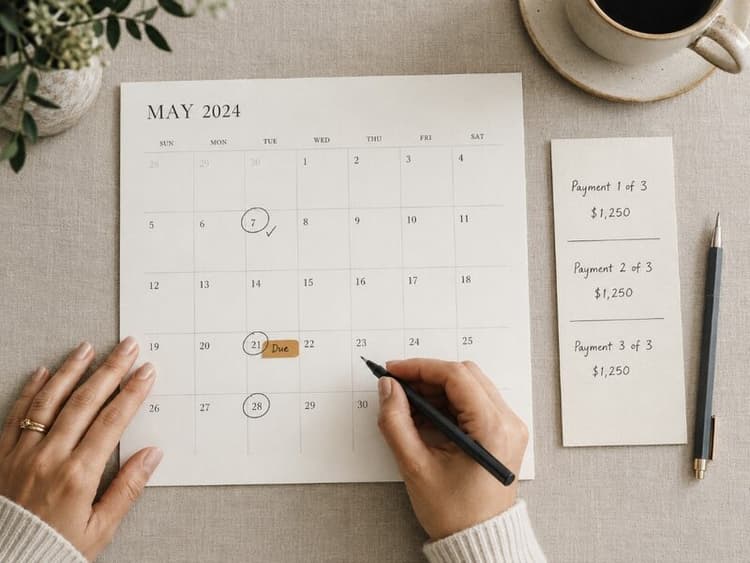
Day 1 past due: Send a short reminder. Don't assume bad intent. People forget.
Hi [Name], just a reminder that your $1,000 installment was due yesterday (November 1). You can send payment via [method]. Let me know if there's an issue.
Day 7 past due (if your agreement has a 7-day default clause): Notify them that the full remaining balance is now due per the agreement.
Hi [Name], the November 1 installment of $1,000 was not received within the 7-day grace period outlined in our payment plan agreement. Per our terms, the full remaining balance of $2,000 is now due immediately.
No response after default notice: This is a collections situation, not a payment plan. Follow the standard escalation path.
👉 Client Won't Pay? A Freelancer's Escalation Plan
If you decide the debt isn't worth pursuing, see When (and How) to Write Off an Unpaid Invoice.
Payment Plans and Your Cash Flow
Agreeing to a plan means your cash arrives later than it should. That's a real cost, even if the money eventually shows up.
Before you agree, check whether you can absorb the delay:
- Will the extended timeline push any of your own bills past due?
- Is the total large enough relative to your monthly income that the delay creates a gap?
- Could you offer a shorter plan (two installments instead of four) that still works for the client?
Shorter plans with larger installments usually protect your cash flow better than long, drawn-out schedules. Two payments of $2,000 over 60 days beats four payments of $1,000 over 120 days in most cases. For forecasting how a plan affects your overall cash position, see Freelance Cash Flow Forecasting.
A Payment Plan Is Not a Discount
One common mistake: letting a payment plan quietly become a price reduction. The client pays two of four installments, goes silent, and you move on because chasing the rest feels awkward.
That's not a payment plan. That's a 50% discount you didn't agree to.
Protect against this by:
- Treating a missed installment as a breach of the agreement, not a "maybe they'll pay next month" situation
- Including an acceleration clause (full balance due on missed payment)
- Keeping deliverables or final files tied to full payment when your contract allows it
For the ownership-transfer clause that gives you leverage here, see Freelance Contracts That Actually Protect Payment.
Quick Reference: Payment Plan vs. Related Billing Structures
| Structure | Best for | Payments tied to |
|---|---|---|
| Payment plan | One fixed total split over time | Calendar dates |
| Milestone billing | Multi-phase projects | Deliverable completion |
| Recurring invoices | Ongoing services (retainers, subscriptions) | Regular billing cycle (can have a fixed end) |
| Deposit + final payment | Upfront risk reduction | Project start and completion |
| Partial payment | Recording money received against an open invoice | Actual payments received |
For milestone billing, see Milestone Billing for Freelancers. For deposits, see Upfront Deposits. For payment terms on every invoice, see Invoice Payment Terms Explained.
Get the terms in writing, invoice each installment with a clear due date, and enforce the schedule when a payment slips.
A payment plan should recover revenue, not defer a problem you never address.
Ready to create clearer invoices?
Create up to 3 invoices per month free. No credit card required.
BillerBear Editorial
Continue reading
Client Says They Paid Your Invoice but You Haven't Received It: What to Do Next
When a client insists they've paid but your bank shows nothing, don't argue and don't mark it paid. Here's a verification-first workflow to diagnose the gap and resolve it.
Net 60 Payment Terms? How to Negotiate Faster Payment as a Freelancer
When a corporate client sends a vendor agreement with Net 45 or Net 60, you don't have to accept it as-is. Counter-offers, scripts, and what AP teams sometimes accept.
Early Payment Discounts for Freelancers: Is 2/10 Net 30 Worth It?
A 2% early-payment discount can equal a 37.2% annualized cost. Learn when 2/10 Net 30 improves freelance cash flow—and when it only cuts margin.